How to Choose a Decorative Box: What It Holds, Size and Material
A decorative box earns its place by its lid. What goes inside decides the size; the room it sits in decides the material.
A decorative box should hold the small things a room needs within reach but not in view: keys, remotes, matches, chargers, cards, jewelry. The lid is the reason to choose a box over a bowl or a tray. It hides what is inside, keeps dust off it, and turns a scatter of small objects into a single form on the surface.
Anything bulky or soft — throws, spare pillows, magazines — belongs in a basket instead. Once the contents are settled, two decisions remain. The box is sized from the inside, not the outside, and its material is chosen for the room: stone for almost any room, horn and bone only where the air stays dry and steady.
What a Decorative Box Should Hold
What should a decorative box hold?
Small, loose things used often and seen rarely. The test is simple: if an object is picked up daily but would look like clutter left out, it belongs in a box.
The contents follow the room. In an entry, keys and sunglasses. In a living room, remotes, matches and a deck of cards. On a dressing table, rings, watches and earrings. On a desk, chargers, cards and the pens that otherwise drift across it.
What does not belong is anything damp, anything that needs air, and anything that has to be found in a hurry by feel. A closed box concentrates whatever goes into it, including moisture. And objects reached for dozens of times a day are usually better on an open tray, where the hand finds them without a lid in the way.
Why the Lid Matters
Should a decorative box have a lid?
Yes — the lid is what distinguishes a box from a bowl. It conceals, it keeps dust out, and it lets ten small objects read as one.
That last point is the one that changes a room. A console holding a box reads as a surface with one object on it. The same console holding its contents loose reads as a surface in use. It is the simplest way to layer objects without clutter, because the layer closes.
How the lid opens matters in daily use. A lift-off lid needs a free hand and somewhere to be set down; a lid that seats onto a profiled rim goes back without searching for the fit. For a box opened many times a day, a lid light enough for one hand is worth more than any detail on top of it.

Measuring a Box from the Inside
What size decorative box do I need?
Measure the contents, not the surface. Lay out what the box must hold, measure the longest item, and remember that the walls take up room — the interior is always smaller than the outside dimensions suggest.
This matters more in stone and inlay than in anything thin-walled. A stone box 10 inches long and 3 inches high takes matches, a deck of cards, a set of keys or a coil of jewelry comfortably. A box 12 by 8 inches and 5 inches high holds what an entry table collects in a week.
Then check the box against the surface. A box should sit with clear space around it, not fill the width of a side table or overhang a shelf edge. The broader principle is set out in understanding scale in decorative objects.
Stone Boxes
Is a stone box good for storage?
Yes. Stone is heavy, stable and inert: it gives nothing off into the closed space, and changes in humidity do not move it. Of all the box materials, it suits the widest range of rooms.
Weight is part of the case. A small stone box weighing around ten pounds stays where it is set, on a console or a bathroom counter, and does not shift when the lid is lifted. Onyx arrives polished and closed at the surface, with light moving through its clouding; travertine can be left raw, its open voids part of the face. The nature of travertine's porosity is worth understanding before choosing it for anything that will be handled often.
Both are calcium carbonate, so both respond to acid and oil the way marble does. Keep citrus, spirits and scented oils off the surface, and wipe the box with a soft, dry cloth after handling. The comparison between marble and onyx covers how the two stones differ in use.
Horn and Bone
How do horn and bone behave as a box?
Both come from animals, and both respond to the air around them. Horn is keratin, the same protein as hair and nails; bone is a mineral bound through with collagen. Humidity and heat move them in ways stone never moves.
An inlaid box is a set of small pieces laid over a base. When the air turns damp, horn and bone swell at a different rate from the base beneath them; when it dries, they shrink back. Repeated often enough, that movement is what loosens an inlay at its edges.
Light is the other factor. The warm browns of horn fade under direct sun, and bone loses its tone as well. None of this makes horn and bone fragile in an ordinary room. It means they belong away from windows, radiators and steam, and that they are dusted with a soft, dry cloth rather than wiped wet.

Which Room Decides the Material
Can a decorative box go in a bathroom?
A stone box can, set clear of standing water. Horn, bone, wood and canvas should not — a bathroom swings from dry to saturated several times a day, and that swing is exactly what loosens an inlay and swells a base.
So the room is the first filter. In a bathroom, onyx or travertine, kept away from the basin and with raw travertine sealed; the principle is the same one that governs choosing bath accessories. In a living room, study or bedroom, where the air stays steady, horn and bone are at home, and their pattern reads well on a console table or an open shelf.
The entry is the one room that tests both. A front door lets in weather, so a box close to it should be stone, and a horn box is better placed further inside the house, in an entryway that stays dry.
Storing Jewelry and Silver
What kind of box is right for silver jewelry?
One that gives nothing off. Silver tarnishes when it meets sulfur in the air, and a closed box concentrates whatever its own materials release. Wool felt and rubber both release sulfur; stone releases nothing.
A lined box is not automatically a better one for silver. A soft felt interior feels protective and may be doing the opposite. An unlined stone box, with each piece wrapped in plain tissue and the box kept somewhere dry, slows tarnish more reliably than a padded one.
Gold and platinum are far less reactive, and largely indifferent to the box. For them, the concerns are scratching and tangling — which is an argument for a box large enough that pieces lie flat and apart.
Boxes in Pairs
Should decorative boxes be stacked?
A pair of different sizes stacks into one form: the smaller on the larger, one footprint, two compartments. Stacked, they read as a single object; separated, they can serve two rooms.
Stacking works where the pattern or material runs over the lid as well as the sides, so the upper box does not interrupt the lower one. On open shelves, a stacked pair also gives height without adding a third object to the row.
Choosing a Box
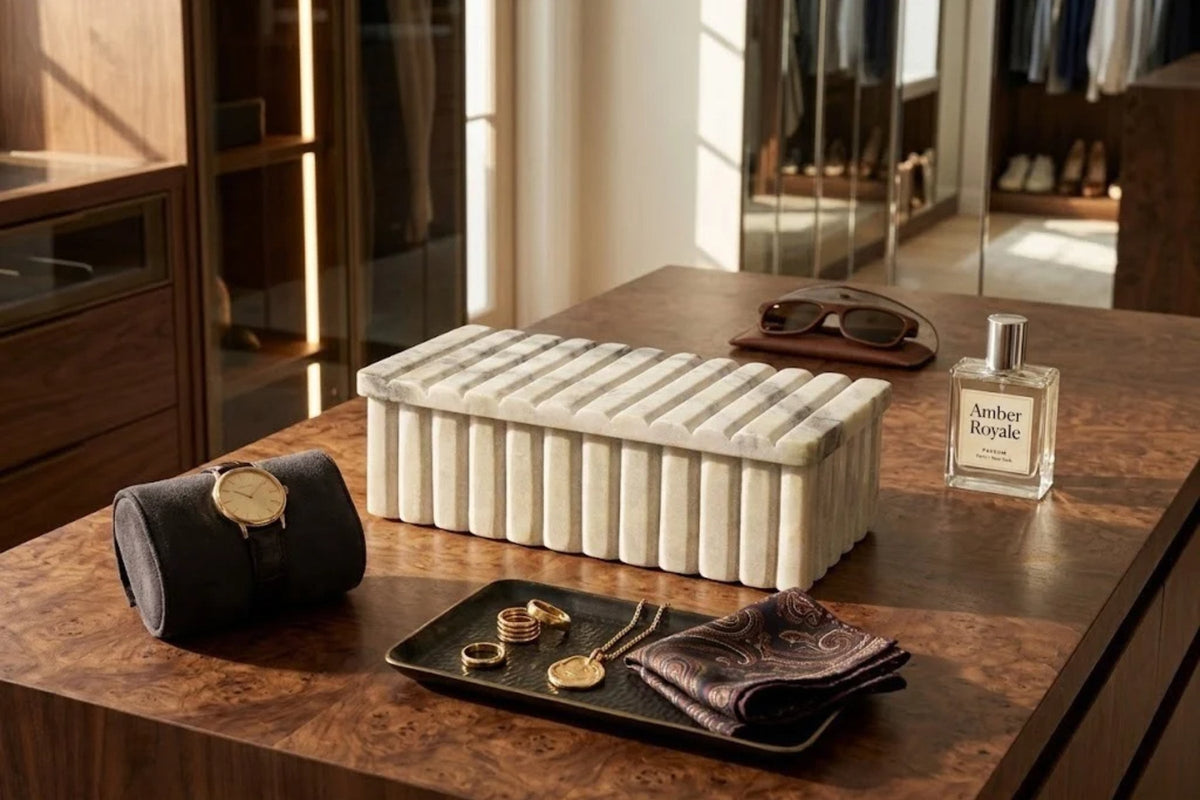
For a box that works in the widest range of rooms, the Cuba box is cut from stone — green onyx, polished and clouded, or fossil gray travertine left raw with its voids open — 10 inches long, with close rounded flutes on every face and a lift-off lid whose ribs give the fingers a grip without a knob.
For a living room or dressing table, the Bindra pair sets off-white bone in an unbroken grid across black horn, over every face and both lids, and the Leela pair works brown horn and off-white bone into an etched diamond mosaic. Both come as a large box and a small one; the Bindra pair was drawn to be stacked, the small box on top. For what a box cannot take — throws, spare pillows — the Gilmore basket is printed canvas over a firm wall that stands upright, full or empty.
Quick Answers
What should a decorative box hold?
Small, loose things used often but not meant to be seen: keys, remotes, matches, chargers, cards and jewelry. The lid hides them, keeps dust off, and turns a scatter of objects into one form. Bulky or soft things such as throws and pillows belong in a basket, and anything damp should not be closed in at all.
What size decorative box do I need?
Size it from the contents. Lay out what the box must hold, measure the longest item, and allow for the walls, since stone and inlaid boxes are noticeably smaller inside than outside. Then check the footprint against the surface: the box should sit with clear space around it rather than fill the table or shelf.
Can a decorative box go in a bathroom?
A stone box can. Humidity does not move onyx or travertine, so either suits a bathroom counter, kept clear of standing water. Horn, bone, wood and canvas should stay out: a bathroom swings between dry and saturated several times a day, and that movement loosens inlay and swells the base beneath it.
What kind of box is right for silver jewelry?
One that releases nothing into the closed space. Silver tarnishes on contact with sulfur, and wool felt and rubber linings both give it off. An unlined stone box, with each piece wrapped in plain tissue and the box kept somewhere dry, slows tarnish more reliably than a soft, felt-lined interior does.
How do you care for a horn and bone box?
Dust it with a soft, dry cloth and keep it away from water, steam, radiators and direct sun. Horn and bone swell and shrink with humidity at a different rate from the base beneath them, which is what loosens inlay over time. Never soak or wipe the box wet, and lift it by the base rather than the lid.
Final Note
A box is one of the few objects in a room that is chosen as much for what it hides as for what it shows. Its surface is the part everyone sees; its interior is the part that decides whether it gets used.
Chosen for its contents first and its room second, a box stops being an accessory and becomes a piece of the room's working order — the place where the small things go, and where they can be found again.