How to Create a Composed Entryway
A quiet threshold where structure, material, and restraint define the first impression of a space
An entryway is the first point of contact within a home. It is where movement begins and settles, where objects are placed, and where the tone of the interior is introduced.
When composed with intention, it does not feel transitional. It feels complete—balanced between function and presence.
Understanding the Role of an Entryway
What defines a well-composed entryway?
An entryway is defined by clarity and structure.
It should hold only what is necessary, arranged in a way that feels ordered and accessible. Each element should serve a purpose while contributing to the overall composition.
The space should feel open, not occupied.
Starting with a Foundation Surface
What is the central element in an entryway?
A console or defined surface anchors the space.
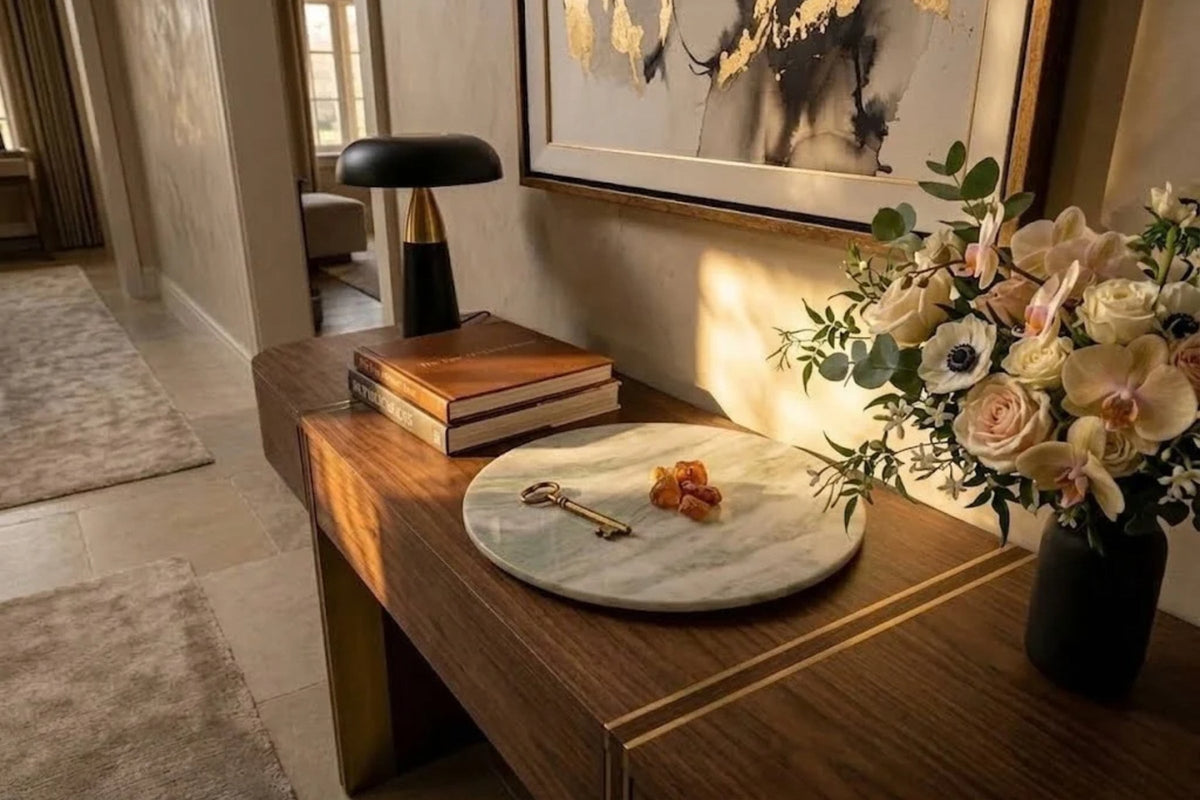
A console table provides structure, offering a place for essential objects while creating a visual foundation. Its scale should align with the wall or area it occupies.
This surface becomes the base for composition.
What the Entry Has to Catch
What does an entryway actually need to hold?
Keys, mail, and whatever comes off at the door.
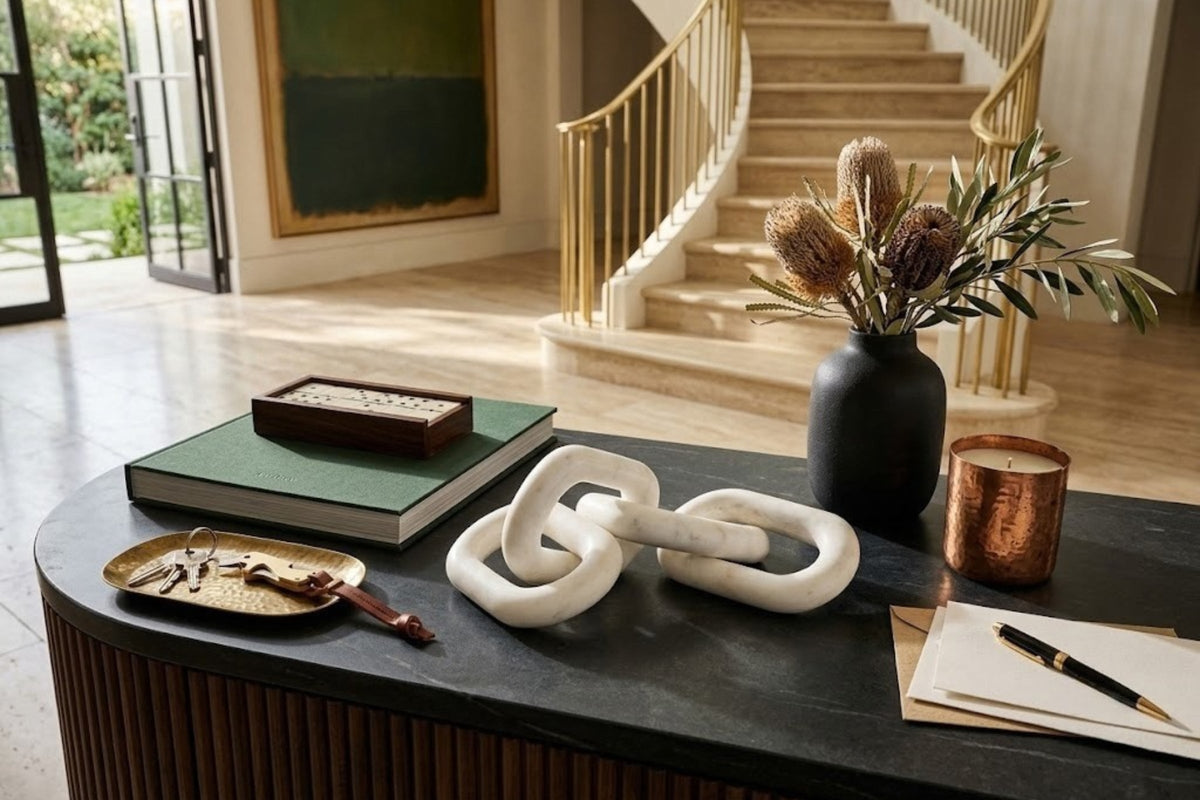
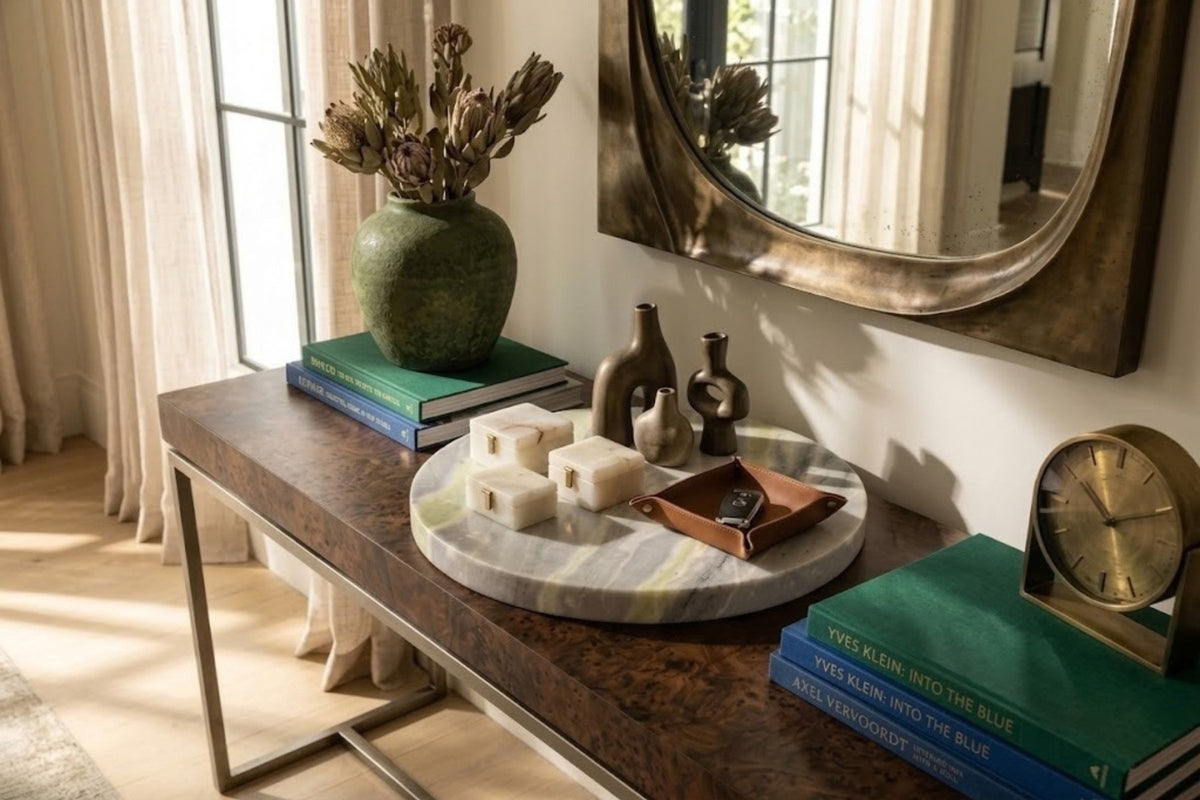
An entry is the only surface in the house with a fixed daily job. Keys arrive and leave twice a day. Mail accumulates against the wall unless something receives it. A watch, sunglasses, a card, a set of headphones come off on the way in. A stone tray or tiered stand set within arm's reach of the door gives all of it one destination, which is the difference between a surface that works and one that collects.
This is where an entry parts company with other surfaces. A console in a living room carries no such obligation and can be composed purely on proportion. An entry console is a working surface first, and the styling has to survive being used at speed, in a coat, with hands full.
Function sets the arrangement. Composition follows it.

Introducing a Focal Element
What should be the visual focus in an entryway?
A single element creates presence.
A stone bowl that anchors the composition, sculptural object, or vessel can act as a focal point. An entry is read in a glance, by someone moving through it, so one object with real weight registers where several small ones do not. Creating quiet focal points in a room sets out how that weight is built.
It establishes a quiet point of attention.
The Mirror's Job at the Door
Why do entryways have mirrors?
Because it is the last surface before leaving and the first on return.
A mirror at the entry does two things a picture cannot. It gives a final check on the way out, which is why it should be hung at eye level for a standing adult rather than centered on the available wall—those are rarely the same height. And it returns light into a space that usually has none of its own, since entries are seldom given a window. Hung opposite or adjacent to the door, it doubles whatever light arrives with the door opening.
The entryway becomes visually cohesive.
Storage at Floor Level
What belongs below the surface?
The bulk that would otherwise sit on it.
The surface fails when it is asked to hold volume. Shoes, a folded throw, an umbrella, a bag set down and not moved again—these belong in a basket beneath the console, contained and below the sightline. Keeping bulk at floor level is what allows the surface above to stay at three objects. It is also how a threshold defines itself as a space rather than reading as a stretch of corridor.
The floor carries what the surface cannot.
Balancing Function and Simplicity
How many items should be placed in an entryway?
Fewer elements create better function.
A tray, one focal object, and a vertical element are often sufficient. Additional items may reduce clarity and make the space feel crowded.
Simplicity supports both use and appearance.
Material and Atmosphere
What materials suit an entryway?
Material sets the tone.
Stone introduces weight and stillness, and it suits a surface handled quickly and without much care. Wood adds warmth. Woven fiber belongs at floor level, where storage takes knocks. These materials should remain cohesive, since a space passed through at speed reads too many materials as noise.
The palette should feel restrained.
Spacing and Movement
How should space be managed in an entryway?
Spacing allows movement.
Objects should be placed with visible space between them, ensuring the surface remains clear and accessible. The entryway should support flow, not interrupt it.
Clarity enables ease.
Adapting to Different Entry Sizes
Can small entryways be styled effectively?
Yes, through restraint.
In smaller spaces, fewer and more compact elements create a composed surface. Larger entryways may hold slightly more presence, though the principle of restraint remains consistent.
Scale adjusts, but the approach does not.
Avoiding Common Entryway Mistakes
What disrupts an entryway?
Excess and inconsistency.
Too many objects, mismatched materials, or lack of structure can make the space feel cluttered. Similarly, leaving the surface undefined may reduce its purpose.
Balance must be maintained.
Quick Answers
How do you style an entryway table?
Start with what has to be caught. A tray or tiered stand within arm's reach of the door for keys and mail, one object with enough weight to hold the surface, and a mirror above at eye level. Keep bulk in a basket underneath rather than on the table.
What should be placed in an entryway?
A defined surface, one container for keys and mail, a single object of some visual weight, a mirror, and floor-level storage for shoes or a folded throw. Anything beyond that competes with the surface's daily job, which is to receive things and release them again.
How do you keep an entryway uncluttered?
Give every category a destination. Keys and mail go in one tray; bulk goes in a basket at floor level; anything without a destination ends up on the surface. The table stays clear because the things that would cover it have somewhere specific to be instead.
Should entryways include decor?
Yes, but sparingly, and after function is settled. One object with real presence does more at a threshold than several small ones, because the space is passed through rather than sat in and is read in a glance. Decoration that obstructs the working area defeats it.
What materials suit entryway styling?
Stone for weight on a surface used quickly and roughly, wood for warmth, and woven fiber at floor level where storage takes knocks. Keep the palette tight: an entry is seen in passing, and too many materials read as noise at that speed.
Final Note
An entryway is not defined by what is placed within it, but by how it is held.
Through structure, material, and restraint, it becomes a space that feels calm and intentional—setting the tone for everything that follows.