Styling a Console Table with Balance and Restraint
A restrained surface where proportion, spacing, and material create a composition that feels intentional and composed
A console table sits between spaces—often in entryways, behind seating, or along a wall—where it introduces structure without occupying the room fully.
Its styling should reflect this position. Neither empty nor filled, it holds a balance between presence and restraint.
Understanding the Role of a Console Table
How should a console table be styled?
A console table should feel balanced rather than decorated.
It is a surface that supports a small number of elements—each placed with intention—allowing the composition to remain clear and open.
Restraint defines its presence.
The Constraints a Console Imposes
What makes a console different from other surfaces?
Depth, length, and the wall behind it.
A console is shallow, commonly twelve to sixteen inches front to back. That single dimension decides the arrangement: objects are placed along a line rather than clustered in depth, and anything with real footprint sits proud of the front edge, where a passing hip or sleeve finds it. A side table presents the opposite problem—small and square, approached from a seat rather than walked past, so depth is available and length is not.
Length is the second constraint, and it is read against the furniture below and around it. A console set behind a sofa or along a wall should carry its objects across roughly the middle two-thirds of its length, leaving the ends open. Filling the full length removes the margin that makes the arrangement read as composed rather than stored. An entryway console adds a third demand on top of both, since it has to catch what comes through the door.
The constraints come first; the objects follow them.

Starting with an Anchor Element
What should be the focal point on a console table?
An anchor creates structure.
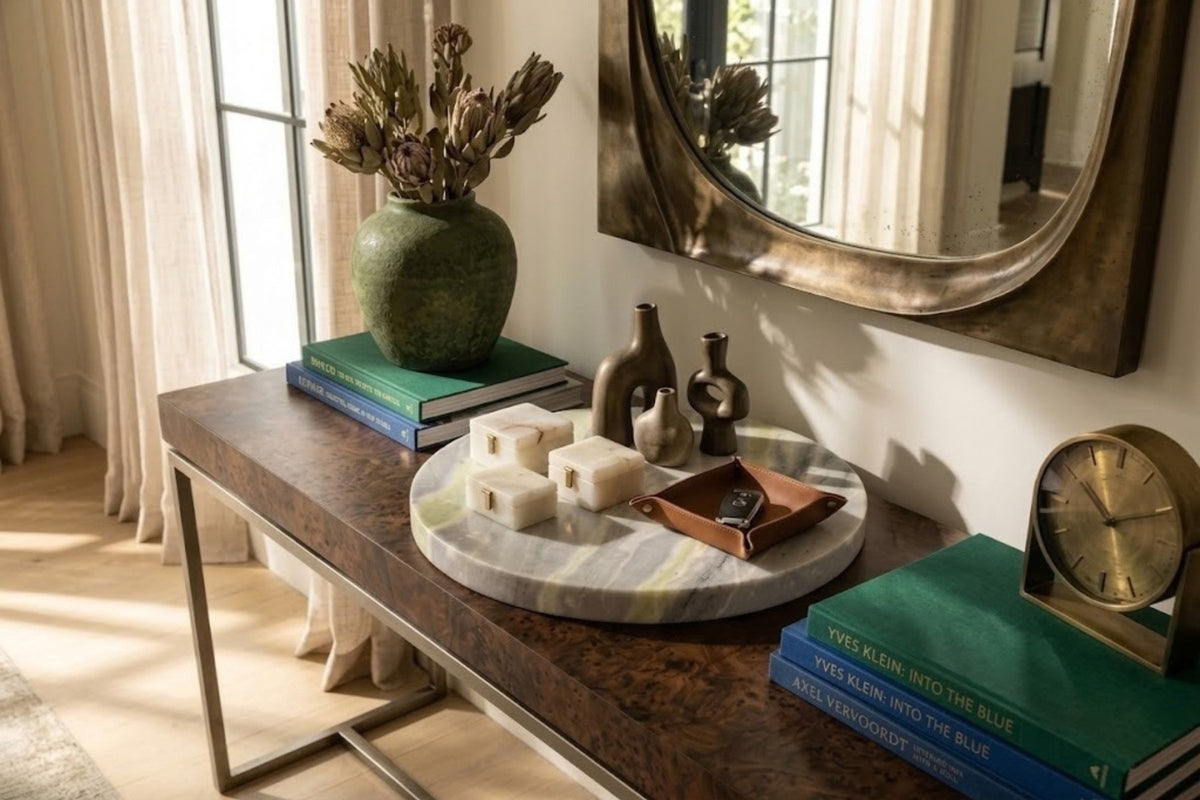
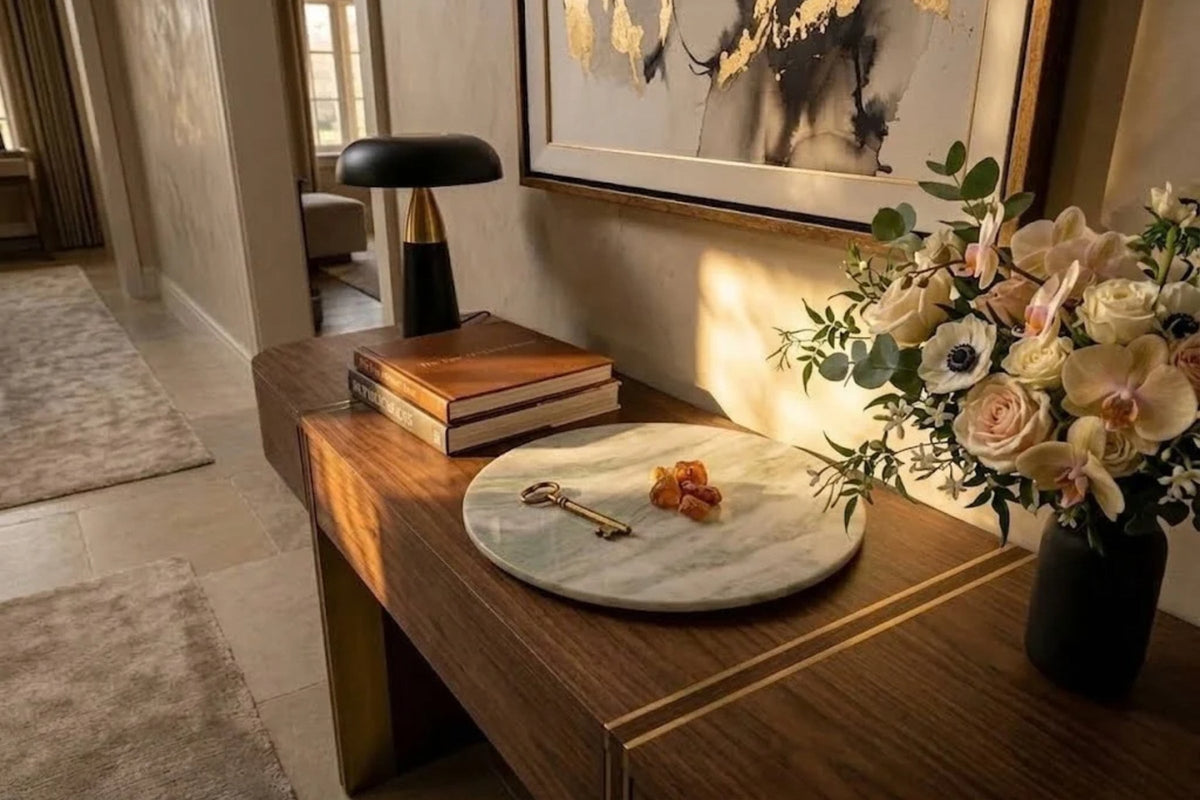
A stone object that anchors the composition, a marble bowl, or a tray can serve as a central element. This piece grounds the surface, providing a point of focus without requiring additional emphasis.
It defines the arrangement from the outset.
Introducing Vertical Balance
Should height be included in console styling?
A vertical element introduces dimension.
A single taller object—such as a vase or sculptural form—adds height without overwhelming the surface. On a shallow console, height is also the only direction available: what cannot be expressed in depth has to be expressed upward.
Height should remain subtle and controlled.
Layering with Restraint
How many objects should be placed on a console table?
Fewer elements create clarity.
A combination of one anchor piece, one vertical element, and a supporting object is often sufficient. Additional items may reduce the clarity of the composition.
Each piece should remain visible and distinct.
Using Trays to Create Structure
How can a tray be used on a console table?
A tray defines a contained area.
Placed on one side or centrally, a marble or onyx tray that gathers everyday objects keeps smaller items unified, preventing them from feeling scattered across the surface. On a narrow console this matters more than elsewhere, since a shallow surface has no room to absorb loose items.
It introduces order without adding volume.
Balancing Left and Right
Should console table styling be symmetrical?
Balance can be symmetrical or asymmetrical.
Symmetry creates a more formal and structured look, while asymmetry introduces a more relaxed composition. In both cases, visual weight should be distributed across the length rather than collected at one end.
The arrangement should feel stable.

Material and Texture
What materials suit a console table?
Material defines tone.
Stone introduces weight and stillness, wood adds warmth, and textiles soften the composition. Combining these materials allows the surface to feel layered while maintaining cohesion.
The palette should remain restrained.
Spacing and Negative Space
How much empty space should be left?
Space defines clarity.
Allowing visible space between objects ensures that each element can be perceived individually. A crowded surface reduces both balance and presence.
Negative space is essential.
Working the Wall Plane Above
How should a console table relate to the wall behind it?
The wall is part of the composition, not a backdrop.
A console is the one common surface with a vertical plane directly behind it, and that plane does much of the work. A mirror or wall panel hung above should clear the tallest object on the surface by roughly six to eight inches—close enough that the two read as one arrangement, far enough that they do not collide. Its width should stay inside the width of the console, so the furniture continues to frame it rather than being overrun.
The same relationship at room scale is covered in creating balance through height and scale.
Avoiding Common Styling Mistakes
What disrupts a console table arrangement?
Excess and imbalance.
Too many objects, inconsistent materials, or lack of spacing can create visual noise. Placing all objects at the same height flattens the arrangement, and on a console that is the harder failure to recover, since depth is not available to compensate.
Variation and restraint must work together.
Quick Answers
How do you style a console table simply?
Work along the line rather than in a cluster, since a console is shallow. One anchoring object, one vertical element, and one supporting piece, distributed across the middle two-thirds of the length, with the ends left open and visible space between each piece.
Should console table decor be symmetrical?
Either works, provided visual weight is distributed evenly across the length. Symmetry suits a console under a centered mirror in a formal setting. Asymmetry reads more relaxed and handles an off-center wall element better. What fails is weight collected at one end with the other left empty.
What can be placed on a console table?
A tray to gather small objects, a low bowl or sculptural form as the anchor, and one taller piece such as a candle holder or vessel for height. Depth is the limit: a console is often twelve to sixteen inches deep, so nothing should sit proud of the front edge.
How do you avoid clutter on a console table?
Limit the count and contain the small things. A tray gathers keys, mail and other loose items into one defined shape instead of several scattered ones. Leave the ends of the console open; the arrangement reads as composed when the surface frames it rather than being filled end to end.
Does a console table need wall decor above it?
It benefits from one. A console is the single surface with a vertical plane directly behind it, and leaving that plane empty makes the table read as unfinished. Hang a mirror or panel narrower than the console, six to eight inches clear of the tallest object on the surface.
Final Note
A console table does not require complexity—it requires balance.
Through proportion, spacing, and material, it becomes a quiet surface that holds presence without excess, shaping the space with restraint and clarity.