Choosing Bath Accessories for Function and Form
A balanced approach to the bath, where material, scale, and restraint shape a composed everyday surface
Bath spaces operate within constraint—limited surface, frequent use, and constant interaction with water. Within this setting, every object must serve a purpose while contributing to a sense of order.
Choosing bath accessories is not about adding more, but about selecting fewer elements that bring both structure and clarity to the space.
Understanding Bath Accessories
What defines well-chosen bath accessories?
Bath accessories balance function with presence.
Each piece should serve a clear purpose—holding, containing, or supporting daily use—while remaining visually composed within the space.
The goal is not decoration, but quiet organization.
Starting with Structure
How should bath surfaces be organized?
Structure begins with containment.
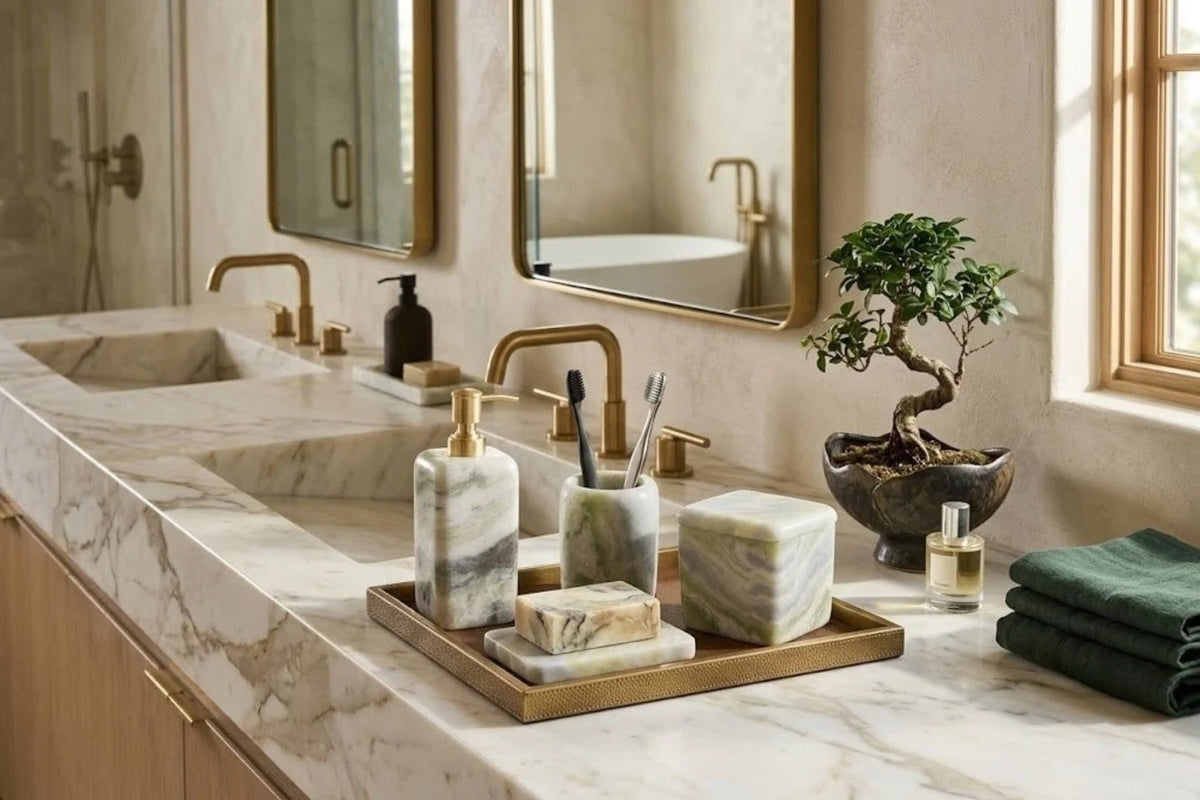
Two approaches work, and they solve the problem differently. A matched set—dispenser, toothbrush holder, lidded canister, soap dish, all turned on one form—reads as a single unit, so four objects occupy the visual space of one. That is what the Bath Accents sets are: four pieces, one form, stone as the only variable between them.
The second approach is a boundary rather than a set. A low stone tray placed beside the basin gathers whatever does not belong to a set—a ring, a comb, a jar brought in and not taken out—inside a defined edge. Stone trays sit in Decorative Objects rather than with the bath sets, and the same piece moves between a counter and a console without adjustment.
Either creates a surface that feels intentional rather than occupied.

Choosing the Right Materials
Which materials suit bath accessories?
Material defines both durability and atmosphere.
Marble and onyx are calcium carbonate: porous, prone to staining, and etched on contact by anything acidic. That matters more in a bathroom than anywhere else in the house, because most of what sits on the counter is acidic. Descalers and limescale removers are acids by design. So are many all-purpose bathroom sprays, and a number of toners and cleansers. Bleach damages stone as well. Stone belongs in a bath setting when it is sealed, kept dry, and kept apart from those products—not because it is fragile, but because it cannot be cleaned the way tile is. Caring for marble and onyx surfaces sets out the routine.
Travertine is more absorbent still, its surface carrying open pores across the face. Travertine porosity, veining, and texture covers what that means in practice. Wood brings warmth, though it benefits from more controlled placement. Cotton and linen textiles soften the space, absorbing and releasing moisture.
Each material should align with both use and setting.
Scale and Proportion
How large should bath accessories be?
Scale should remain contained.
Smaller, well-proportioned pieces are more appropriate for bathroom counters and shelves. Larger objects may overwhelm the surface, reducing clarity and usability.
Each element should feel proportionate to the space it occupies.
Balancing Function and Simplicity
How many bath accessories are necessary?
Fewer elements create better function.
A set of vessels, one contained area for loose items, and a textile layer are often sufficient. Additional items rarely improve usability and may disrupt the overall composition.
Restraint ensures both clarity and ease of use.

Placement and Accessibility
Where should bath accessories be placed?
Placement follows daily use.
Items should sit within reach of the basin, grouped in a defined area rather than spread across the surface. Keep the group clear of the tap, where splash lands. Textiles may be placed slightly apart, allowing airflow while remaining accessible.
This separation supports both function and visual balance.
Material Behavior in Moist Environments
Do bath materials require special consideration?
Stone does, and the reason is specific.
Standing water on calcium carbonate leaves limescale as it evaporates. Removing limescale is exactly what acidic descalers are sold to do, which is how a stone bath piece ends up etched—the treatment for the deposit attacks the stone the deposit sat on. Drying the piece after use removes the problem at the start. Everyday care for bath accents covers the routine in full. Textiles absorb and release moisture. Wood needs controlled exposure to hold its surface.
Understanding this behavior allows for more thoughtful placement.
Maintaining a Composed Surface
How can a bathroom counter remain uncluttered?
Clarity comes from defined zones.
Grouping objects within a tray or a matched set prevents visual spread, while leaving portions of the surface open maintains balance. This approach ensures the space remains both usable and composed.
Order is created through containment.
Avoiding Common Mistakes
What disrupts a bath setting?
Excess and inconsistency.
Too many objects, mismatched materials, or oversized pieces can make the space feel crowded. Similarly, placing items without structure reduces both usability and visual clarity.
Selection should always be intentional.
Applying Bath Accessories Across Spaces
Can this approach work in all bathrooms?
Yes, across different scales.
Whether in a compact bath or a larger setting, the principle remains the same—structure, restraint, and material balance define the space.
The composition adapts, but the approach remains consistent.
Quick Answers
How do you organize bathroom accessories without clutter?
Group the essentials inside one defined area rather than spreading them across the counter, limit the set to a few pieces that each do a job, and leave visible space between them. A matched set of vessels reads as one unit, which holds a small surface better than assorted containers.
What materials suit bathroom accessories?
Sealed marble, onyx and travertine give structure and weight, provided they are kept dry and away from acidic cleaners. Cotton and linen handle moisture well and soften the room. Wood needs controlled exposure. The material question in a bathroom is less about appearance than about what it meets daily.
How many items should be on a bathroom counter?
Only what is used daily: a container for soap, one or two vessels for the things that come off the shelf every morning, and a textile layer. Anything used weekly or less belongs behind a door. A counter with open surface left on it stays easier to clean.
Where should bath accessories be placed?
Within reach of the basin, grouped in one defined area rather than distributed across the counter. Keep the group away from the tap so pieces are not standing in splash. Textiles sit slightly apart from the rest, where air can move around them and they dry between uses.
Are stone bath accessories suitable for daily use?
Yes, with maintenance. Wipe them dry after use, because standing water leaves limescale on calcium carbonate. Keep acidic cleaners, descalers and bleach away from the stone entirely, since those etch and dull the polish on contact. Handled that way, a sealed stone set holds up to daily use indefinitely.
Final Note
A bath space does not require more—it requires clarity.
Through material, proportion, and restraint, even a small surface can feel composed—where each object holds purpose and nothing remains without intention.