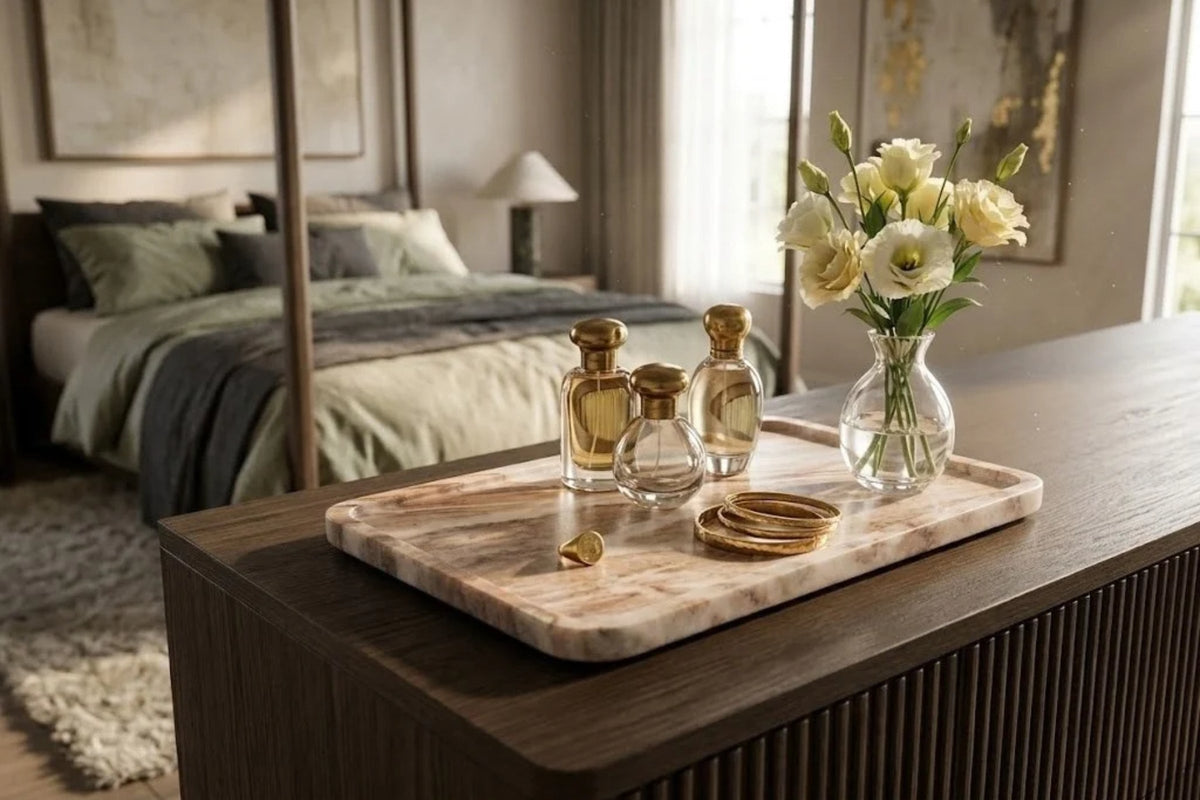
Styling a Side Table with Minimal Elements
A restrained composition where proportion, material, and space define a surface with quiet clarity
A side table holds less—but asks for greater intention.
Its scale requires restraint, where each object carries presence and nothing feels incidental. The surface becomes defined not by what is added, but by what is left out.
Understanding Minimal Composition
What defines a well-styled side table?
A side table is defined by clarity and proportion.
Unlike larger surfaces, it cannot hold multiple competing elements. A few objects, placed with care, create a composition that feels complete without excess.
The focus shifts from quantity to placement.
Starting with a Single Anchor
What should be the first element on a side table?
A single grounding object establishes the composition.
A chiseled onyx block with a bowl polished into its top, a small tray, or a sculptural form can define the visual center, allowing the remaining elements to align naturally around it.
Without this anchor, the arrangement may feel unstructured. The same principle governs a larger surface, where styling a console table with balance and restraint begins from one defining element and works outward.
Introducing a Secondary Element
How many objects should be added?
One additional element is often sufficient.
A book, a small vessel, or a candle introduces variation in form or height. This second element should complement the anchor rather than compete with it.
Together, they create balance without filling the surface. Where more than two objects are involved, the method is closer to layering decorative objects without clutter, where space between pieces carries the composition.
Using Height with Restraint
Should vertical elements be included?
Height should remain subtle.
A single vertical element—such as a candle or small vase—can introduce height, but should remain proportionate to the table’s size. Excess height can disrupt the composition on a smaller surface.
Restraint maintains balance.
Spacing and Surface Visibility
How much space should remain on a side table?
Space is essential to clarity.
Allowing visible surface area ensures that each object remains distinct. When objects are placed too closely, the composition may feel crowded despite having few elements.
A side table should never feel filled.
Material Balance on a Small Surface
How do materials influence a side table arrangement?
Material defines presence.
Stone objects that introduce quiet weight bring stillness, while wood or textiles soften the composition. A stone element paired with a lighter material creates contrast without complexity.
This balance allows the surface to feel layered without becoming dense. Given enough clear space around it, the anchoring object can also read as a quiet focal point within the room.
Placement Relative to Seating
Where should objects sit on a side table?
Placement should follow reach and proportion.
Objects should be positioned slightly off-center or grouped toward one side, allowing the table to remain functional. This ensures both usability and visual balance.
The arrangement should support the space, not interrupt it.
Avoiding Over-Composition
What disrupts a minimal side table?
Excess and uniformity both create imbalance.
Too many objects remove clarity, while objects of equal size may feel static. Variation, introduced sparingly, creates a more natural composition.
Minimal does not mean empty—it means considered.
Applying Minimal Styling Across Spaces
Where can this approach be used?
Minimal composition applies across settings.
Beside a sofa, it supports a living area. Near a bed, it maintains calm. Along a chair or reading corner, it introduces quiet structure.
The principle remains consistent—less, placed with intention.
Quick Answers
How do you style a small side table without clutter?
Begin with one grounding object and add a single supporting element beside it. Leave visible surface around both so each reads as distinct. A side table cannot hold competing elements the way a larger surface can, so the composition is defined by what is left out rather than added.
What should be placed on a side table?
An onyx bowl, a small tray, a candle, or a single sculptural form, kept proportionate to the surface. One object grounds the arrangement and a second introduces variation in height or material. Beyond that, the table stops reading as composed and begins to read as filled.
How many items should be on a side table?
Two to three elements are generally sufficient. One anchors, one supports, and a third may introduce height if the surface allows it. The count matters less than the space between them, which is what keeps each object legible rather than absorbed into a group.
Should side table decor be centered or offset?
A slightly offset grouping reads as more natural and keeps the table usable. Centering every object can make the arrangement feel static and formal, while shifting the composition toward one side leaves clear surface for a glass or a book within easy reach.
Does material matter in small surface styling?
Yes. Pairing a heavier material with a lighter one creates balance without adding objects. Stone brings stillness and visual weight, while wood or textile softens the composition. On a small surface, contrast in material does the work that additional pieces would do on a larger one.
Final Note
A side table does not require completion—it requires clarity.
Through restraint, proportion, and placement, even the smallest surface can feel composed, balanced, and quietly resolved.