

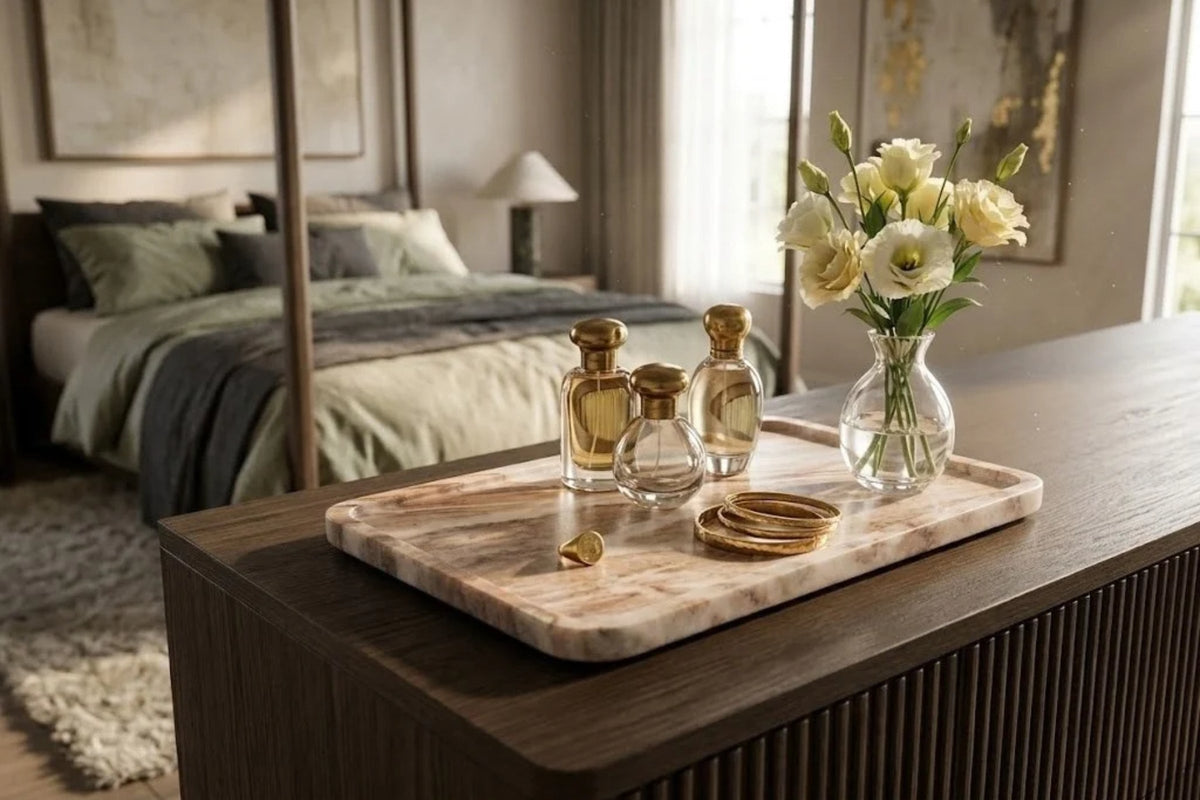
Creating Quiet Focal Points in a Room
A restrained emphasis where a single element holds attention without overwhelming the space
Not every space requires a dominant feature. In refined interiors, focal points emerge quietly—through material, placement, and proportion rather than contrast or excess.
A fluted onyx bowl on a coffee table, a stone tray on a console, or a rug grounding a seating area—each can become a point of focus when allowed to stand with clarity.
Understanding a Quiet Focal Point
What defines a focal point in a room?
A focal point is where the eye naturally settles.
It is not created through volume or intensity, but through balance. A single object or surface becomes prominent by how it is placed and what surrounds it.
Restraint allows it to hold attention without demand.
Choosing the Right Element
What objects can serve as focal points?
A focal point often begins with one defining element.
A stone bowl that holds quiet visual weight placed centrally, a sculptural tray on a console, or a rug beneath a seating arrangement can establish visual orientation within the room.
The material should carry presence—stone, in particular, offers weight and clarity. On a low surface, the approach follows the same logic as styling a marble bowl on a coffee table, where one object is allowed to hold the center.

Placement and Visibility
Where should a focal point be positioned?
Placement determines visibility.
A focal object should sit where it can be seen without obstruction—often centered on a surface or aligned with the room’s natural lines. This ensures that it remains legible within the overall composition.
Obscured placement weakens its presence.
Creating Space Around the Object
How does spacing affect a focal point?
Space defines emphasis.
Allowing negative space around an object ensures that it remains distinct. When surrounded by too many elements, even a strong object may lose clarity.
Absence becomes part of the composition.
Material and Visual Weight
Do materials influence focal strength?
Material defines presence.
Stone objects that carry natural weight—marble or onyx—become effective focal points even in minimal settings. Wood introduces warmth, while textiles create a softer, more diffused focus.
The choice of material shapes how attention is held.
Scale and Proportion
How large should a focal point be?
Scale should feel proportionate to the room.
A larger space may require a broader or slightly more prominent element, while smaller settings benefit from contained, quieter focal points. Oversized objects may dominate, while undersized ones may disappear.
Balance ensures presence without excess. Working across a group of objects, this becomes a question of creating balance through height and scale.
Supporting Elements and Subtle Layering
Should a focal point be styled with other objects?
Supporting elements should remain secondary.
A book, a candle, or a smaller object may sit beside the focal piece, but should not compete with it. Their role is to reinforce the composition rather than divide attention.
Hierarchy must remain clear.

Light and Emphasis
Does lighting affect a focal point?
Light enhances presence.
Natural or soft indirect light can draw attention to an object, revealing material depth and surface variation. Marble and onyx are both translucent: light enters the surface and scatters just beneath it rather than stopping at the face. Onyx is the more translucent of the two and the more visibly banded, so light travels further within it and reads as an internal glow, strongest where the stone runs thin at an edge.
This is covered further in light interaction with natural materials. Lighting should support, not spotlight.
Avoiding Overstatement
What weakens a focal point?
Excess reduces clarity.
Multiple competing elements, strong contrast, or overly decorative arrangements can fragment attention. A focal point is most effective when it is singular and supported by restraint.
Simplicity strengthens presence.

Applying Focal Points Across Spaces
Where should focal points be created?
Every space benefits from a point of orientation.
On a coffee table, it anchors the living area. On a console, a long green onyx tray with brass handles defines entry. On a dining table, it gathers the surface. Within a bedroom, it may sit quietly beside the bed.
Each focal point shapes how the space is read.
Quick Answers
How do you create a focal point in a living room?
Place one object with visual weight, such as an onyx bowl or a stone tray, at the center of a surface and leave clear space around it. The surrounding absence is what gives it emphasis. Supporting objects may sit nearby, but none should compete for the same attention.
What makes a strong focal point in home decor?
A single object with presence, placed where it can be seen without obstruction and supported by minimal surrounding elements. Material carries much of the effect, since stone holds weight and clarity that lighter pieces cannot. Hierarchy must stay legible, with one element clearly primary.
Should a focal point be large or subtle?
It should be proportionate to the room, and more often subtle than dominant. A larger space can carry a broader element, while a smaller setting benefits from something contained. Oversized objects take over the composition, and undersized ones disappear into what surrounds them.
Can multiple focal points exist in one room?
Each zone may hold its own focal point, so a living area, a console, and a dining surface can each have one. Within a single surface, however, one element should remain primary. Competing centers on one surface fragment attention rather than directing it.
Does lighting help define a focal point?
Yes. Soft or indirect natural light reveals material depth and surface variation, drawing attention without spotlighting. Translucent stone responds particularly well, since light entering the surface scatters just beneath it. The aim is to support the object rather than stage it.
Final Note
A focal point does not need to command attention to be seen.
When placed with intention and supported by space, it becomes a quiet center—shaping the room through presence rather than emphasis.