How to Choose Salad Servers: Material, Length and the Pair
A pair of salad servers is two different tools, not one tool made twice — and the material that meets the dressing matters more than the material that meets the hand.
Salad servers are made of wood, stainless steel or resin, and most pairs combine two of them: a head in steel or wood, a handle in something else. The head is where the choice is made, because it sits in the dressing. Wood and stainless steel stay unchanged in vinegar and citrus. Brass and copper do not.
After the head come two practical questions. Length decides whether the servers stay where they are left in the bowl, and most pairs run 10 to 12 inches. The handle decides whether they can still be held once dressing is on the fingers. Everything else is a matter of form.
What Salad Servers Are Made Of
What are salad servers made of?
Wood, stainless steel or resin, often in combination. Wood and steel are the usual materials for the head; resin, rattan and rope appear more often on the handle.
Wood is the oldest answer. A dense, close-grained wood such as acacia takes up little of the dressing it sits in, and it is gentle on whatever bowl it is used in. It asks for hand washing and an occasional oiling, both covered in caring for wood.
Stainless steel is the most neutral. The chromium in the alloy forms an invisible film at the surface, which is why steel can stand in a vinaigrette through a whole meal without reacting. Gold-toned servers are very often stainless steel with a gold finish, not brass, and it is worth checking which.
Resin is a handle material first. It takes color and veining all the way through, holds a shape that wood or steel could not, and stays comfortable in the hand. Where a pair combines materials, the join is where they meet — and the head is the part to read first.
Which Materials Can Sit in Dressing
Can salad servers react with salad dressing?
Some can. Stainless steel and wood are unreactive with vinegar, citrus and wine. Brass and copper are not — acid draws copper out of the metal and into the food.
A vinaigrette is an acid, and the same acids that etch a marble surface work on reactive metals. Brass is copper and zinc. Left standing in a dressing, an unlined brass head dulls, discolors and passes a trace of copper into the salad, which is why plain brass has long been kept away from acidic food.
None of this rules brass out of a serving set. It rules it out of the dressing. A brass handle on a steel head is a different object from a brass head, and the description will say which it is. The part that stays in the bowl through the meal should be steel or wood.

Why a Pair Is Not Two of the Same
Why do salad servers come as a spoon and a fork?
Because each does half of the lift. The spoon carries; the fork holds the leaves against it. Two spoons scatter a salad, and two forks drop it.
The two heads work against each other like a pair of hands. The fork presses down and closes the gap, and the spoon takes the weight underneath. That is why well-drawn pairs are deliberately unmatched: one deep and closed, the other open and notched.
Head shape follows the salad. A wide, shallow head suits loose leaves, which need area more than depth. A deeper spoon suits a chopped salad or grains, where the pieces are small and the dressing pools. A slotted spoon lets dressing run back into the bowl before a serving reaches the plate.
How Long Salad Servers Should Be
How long should salad servers be?
Long enough to reach the bottom of the bowl with a hand's width of handle still above the rim. Most run 10 to 12 inches, which suits a bowl up to about 12 inches across.
A server that is too short slides into the salad the moment it is set down, and has to be fished out with fingers. One that is too long levers itself out of the bowl and takes a chair's width of table with it. The bowl sets the measurement, not the other way around.
For a large bowl — 14 inches across and more, and correspondingly deep — the usual 10 to 12 inch pair is not enough, and servers nearer 16 inches are what reach the bottom. For a salad dressed at the table, one old habit is worth keeping: pour the dressing into the empty bowl, cross the servers over it, and pile the leaves on top, so nothing wilts before it is tossed.
What Happens at the Rim
Why do salad servers slide into the bowl?
Because too much of their weight sits inside the rim. A server resting on the edge of a bowl is a lever, and whichever side is heavier wins.
A long steel handle with a light head stays put. A heavy head on a slender handle tips into the salad. Pairs drawn with this in mind put the weight behind the rim — a weighted terminal at the end of the handle, or a handle angled so that it rests level across the edge rather than pointing into the bowl.
A flexible handle solves it differently. Where the handle can bend over the rim rather than sit rigidly across it, the server settles into place instead of balancing there.
The Handle, Once Dressing Is on the Hands
Which handle material gives the surest grip?
One with texture. Oil from the dressing reaches the fingers within the first few passes, and a smooth polished handle begins to slip. Braid, rope, carving and facets all hold.
This is the practical case for mixed materials. A braided rattan handle stays dry to the touch when the fingers are not; a twisted or faceted metal handle gives the hand an edge to close on; carved wood offers the same through its form. A handle with a defined stop — a collar, a knot, a raised detail — also keeps the fingers from creeping down toward the head.

Servers and the Bowl They Go In
Will metal salad servers mark a bowl?
On a glazed ceramic bowl, steel can leave faint gray lines. They are metal left behind on the glaze, not scratches in it, and they lift with a mild cleanser. Wood leaves nothing.
The glaze is harder than the steel, which is why the mark sits on the surface rather than in it. A wooden or resin head avoids the question entirely, and is the quieter choice for a bowl kept for years.
A stone bowl raises a different issue. A dressed salad is exactly what etches marble, so it belongs in a glazed, glass or wooden bowl rather than directly in stone. A marble bowl is better kept for fruit, bread and anything dry, and the wider case for everyday serveware follows the same line.
Caring for Each Material
Can salad servers go in the dishwasher?
Most should not. Heat, standing water and strong detergent are hard on wood, rattan, resin and gold finishes alike. Plain stainless steel tolerates it, though a rinse before the dressing dries keeps it bright.
Each material fails in its own way. Wood swells, raises its grain and eventually splits. Rattan takes up water and loosens its weave. Resin softens or clouds under sustained heat. A gold finish on steel lasts longer when it is washed by hand and dried at once.
The routine is the same for all of them: warm water, a little mild soap, a soft cloth, and drying straight away rather than leaving the pair to stand on a rack. Servers used this way last as long as the bowl they are used with.
Choosing a Pair
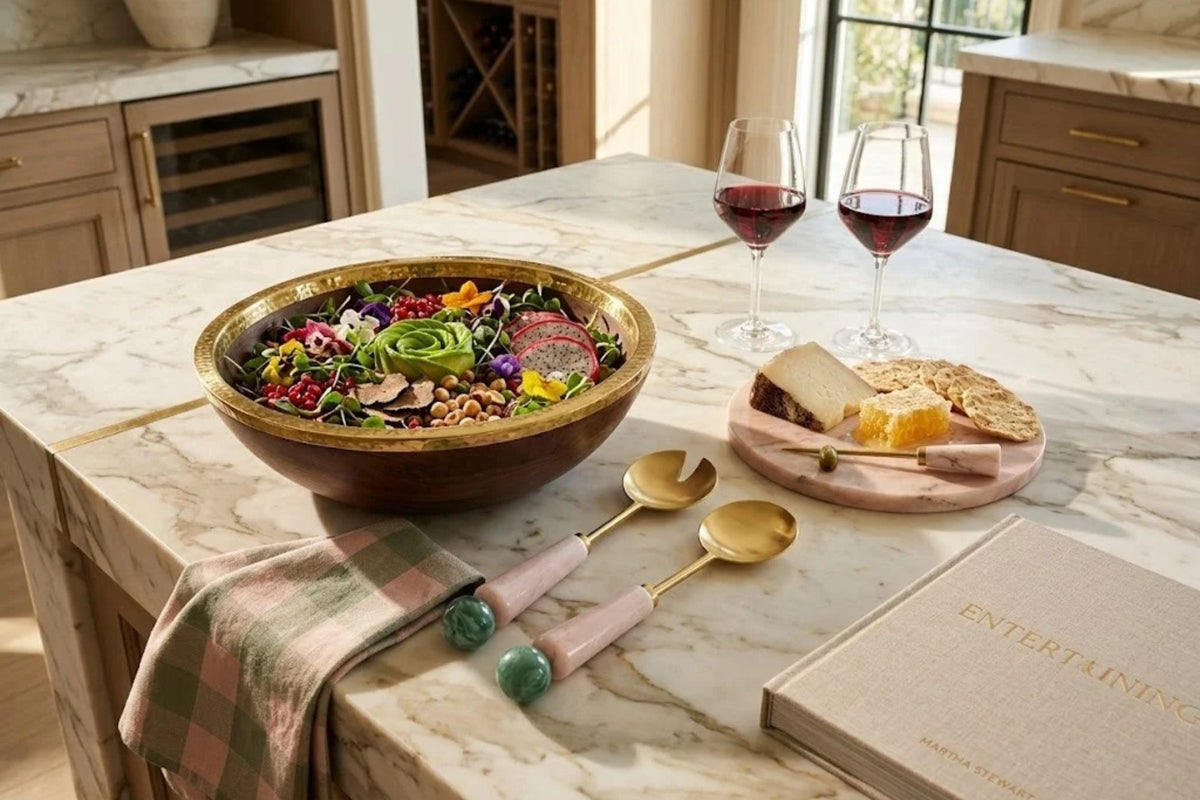
For a wooden pair, the Valencia servers are solid acacia at 12 inches, each handle a run of open links cut from one length of wood, so the handles drape over the rim rather than levering out of it. The Copenhagen pair, also 12 inches, puts matte gold stainless steel heads on veined blush resin, with a jade green sphere closing each grip — weight behind the rim, and a place for the thumb to land.
Where a shorter reach suits a smaller bowl, the Helsinki servers run 10.5 inches in braided rattan over steel, with a round bowl and a crescent fork in matte gold that rest level across the edge. The Imperial pair is brushed gold stainless steel throughout, a rope-twisted handle under a cast bow — steel rather than brass, and light enough to pass around a long table.
Quick Answers
What are salad servers made of?
Salad servers are made of wood, stainless steel or resin, often combined in one pair. The head, which sits in the dressing, is usually wood or stainless steel because neither reacts with vinegar or citrus. Resin, rattan and rope appear more often on handles, where they add grip and color without touching the salad.
Are brass salad servers safe with vinaigrette?
A brass head should not stand in an acidic dressing. Brass is copper and zinc, and vinegar, citrus and wine draw copper out of the metal, dulling the surface and passing a trace into the food. Brass on the handle is fine. The part left in the bowl through a meal should be stainless steel or wood.
How long should salad servers be?
Long enough to reach the bottom of the bowl with a hand's width of handle still above the rim. Most pairs run 10 to 12 inches, which suits a bowl up to about 12 inches across. A bowl of 14 inches or more, and deep with it, needs servers nearer 16 inches.
Why do salad servers come as a spoon and a fork?
Each does half of the lift. The spoon carries the weight from underneath, and the fork presses the leaves down against it so nothing falls away. Two matching spoons scatter a salad and two forks drop it, which is why well-drawn pairs are deliberately unmatched: one deep and closed, one open and notched.
Can salad servers go in the dishwasher?
Most should be washed by hand. Dishwasher heat, long immersion and strong detergent split wood, loosen rattan, cloud resin and dull gold finishes. Plain stainless steel tolerates a machine, though rinsing the dressing off first keeps it bright. Warm water, mild soap and drying at once suit every material in a serving set.
Final Note
Salad servers are small objects asked to do a precise job in a wet, acidic, oily setting, and most of what separates a good pair from a poor one happens out of sight — in the metal of the head, the balance at the rim, the texture under the fingers.
Chosen for those things first, a pair becomes one of the pieces that stays on the table through the meal rather than being carried back to the kitchen after the first pass. The form can then be whatever the table calls for.