How to Choose the Right Marble Bowl
A sculptural choice shaped by proportion, depth, and the quiet presence of stone within a space
A stone bowl is both object and surface. It holds what is placed within it, yet often defines the space even when left empty.
Choosing the right bowl is not only about size or function—it is about how form, weight, and material settle into the surface it rests upon.
Understanding the Role of a Stone Bowl
What is the purpose of a stone bowl in a home?
A bowl in marble or onyx anchors a surface.
Placed on a coffee table, console, or dining setting, it creates a focal point—holding presence through material and form rather than decoration.
It becomes a point of stillness within the room.
One point first, because it decides how the rest of this reads. Marble and onyx are the same mineral—calcium carbonate—cut at close to the same density and the same hardness, and both are translucent. A bowl carved in one behaves exactly as a bowl carved in the other: the same weight for the same volume, the same response to a polish or a honed finish, the same care. What separates them is optical. Marble carries veining that branches and drifts across the stone; onyx carries banding that runs in broader, more directional sweeps. The choice is a looking decision, not a performance one, and marble and onyx compared goes further into it. Everything below applies to a stone bowl in either material.
Choosing the Right Size
How should bowl size be selected?
Size should reflect the surface it occupies.
A larger bowl suits open surfaces such as coffee tables or dining tables, where it can anchor the space. A smaller bowl feels appropriate for consoles, bedside settings, or more contained areas.
The bowl should feel proportionate—neither dominating nor disappearing.

Understanding Depth and Form
Does the shape of the bowl matter?
Form defines how the bowl is experienced.
A shallow bowl feels open, allowing the stone surface and its veining or banding to remain visible. A deeper bowl gathers inward, creating a more contained and sculptural presence.
Each form offers a different sense of balance.
Proportion and Visual Weight
How does proportion affect presence?
Proportion shapes how weight is perceived.
A wide, low bowl may feel lighter within a space, while a deeper or thicker form carries greater visual weight. The relationship between width, depth, and edge thickness determines how the bowl settles on the surface.
Balance is achieved through these proportions.

Selecting Based on Placement
Where should a stone bowl be placed?
Placement guides selection.
On a coffee table, a broader bowl creates openness—styling a stone bowl on a coffee table sets out how it sits against the other objects there. On a dining table, it may hold a central position with quiet presence. On a console or bedside, a smaller, more contained bowl feels appropriate.
The setting defines the form.
Material and Veining Considerations
Does veining affect the choice of bowl?
Veining and banding shape visual character.
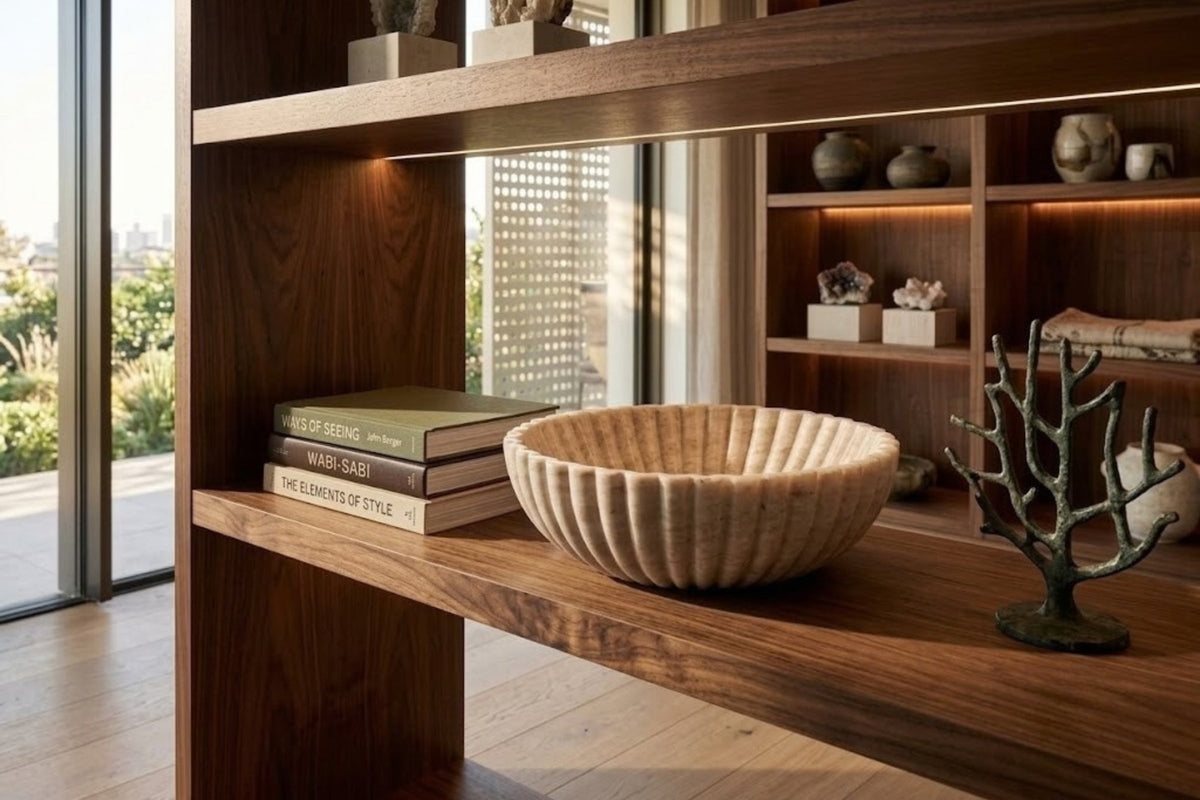
White marble carved with angled ridges carries fine mineral shading and reads close to plain. Beige onyx fluted from base to a scalloped rim carries warmer movement, with gray and ochre distributed through it. Some stones show pronounced mineral movement, others appear softer and more diffused. This variation does not change function or durability—both stones are the same material—but it decides how the bowl is perceived within the space.
Selection should respond to overall tone rather than exact pattern.
What the Bowl Holds
Should a stone bowl be used or left empty?
It moves between both.
It may hold fruit, objects, or remain unfilled—often as a sculptural stone object within the space, where its form alone defines the composition.
Fruit comes with one condition. Because marble and onyx are calcium carbonate, citrus, wine, and vinegar etch the surface on contact rather than gradually, leaving a dulled patch that does not reverse. Apples, walnuts, and whole stone fruit sit in a stone bowl indefinitely; a cut lemon or lime needs a liner or a different bowl. Marble and food safety covers what the stone will and will not take.
Within that, its presence is sufficient.

Balancing Function and Form
Is a stone bowl decorative or functional?
It exists between both roles.
While it may be used daily, its form and material ensure it remains visually grounded even when not in use. The distinction between function and display becomes secondary.
The bowl defines the surface either way.
Avoiding Common Selection Mistakes
What should be avoided when choosing a stone bowl?
Mismatch in scale or context.
A bowl that is too small may feel disconnected, while one that is too large may overwhelm the surface. Choosing without considering placement often leads to imbalance. Choosing on material alone leads to the same place, since marble and onyx perform identically.
Selection should always begin with context.
Applying Stone Bowls Across Spaces
Where can stone bowls be used?
Across multiple settings.
From coffee tables to dining surfaces, consoles to bedside arrangements, bowls in marble and onyx adapt to different environments while maintaining their presence.
They remain consistent in form, yet flexible in use.
Quick Answers
How do you choose the right size marble bowl?
Size the bowl to the surface it will sit on, not to what it will hold. A coffee table or a dining table takes a wide, low form; a console or a bedside surface takes something contained. The same rule applies in marble and in onyx—the stones are interchangeable by weight.
Which shape of stone bowl suits a surface?
A shallow bowl keeps the stone's veining or banding in full view and reads open. A deeper form gathers inward and carries more visual weight. Marble and onyx behave identically here, so shape and depth decide the effect, not which of the two stones was carved.
Where should a marble bowl be placed?
On a coffee table, a dining table, a console, or a bedside surface—anywhere a single object can hold the center and the rest can stay clear. Keep it off surfaces that take standing water or direct heat, and off anywhere a citrus half is likely to be set down.
Should stone bowls be used for serving or display?
Both, within one limit. Marble and onyx are calcium carbonate, and citrus, wine, and vinegar etch them on contact rather than gradually. Apples, walnuts, and bread sit in a stone bowl indefinitely; lemons and limes need a liner. Etching is wear, and it does not reverse.
Do marble bowls vary in appearance?
Every bowl does, because each is cut from a different section of slab. Marble carries veining that branches and drifts; onyx carries banding that runs in broader directional sweeps. Neither can be specified in advance, and two bowls of the same model will not hold the same pattern.
Final Note
A stone bowl is not chosen only for what it holds, but for how it sits within a space.
Through proportion, form, and material, it becomes a quiet center—shaping the surface with presence rather than excess.