Is Marble Safe for Serving Food?
Marble is food safe. What it is not is acid resistant — and that difference is what shapes how a serving piece ages.
Marble is safe to serve food on. It is calcium carbonate — inert, non-toxic, and no more hospitable to bacteria than quartz, even when left unsealed.
The question worth asking is not about safety but about acid. Lemon, wine, vinegar and tomato dissolve a microscopically thin layer of polished marble and leave a dull mark behind. That mark is an etch, not a stain. Knowing the difference is what allows a marble serving piece to be used rather than protected.
What Marble Is
What is marble made of?
Marble is metamorphosed limestone, composed almost entirely of calcium carbonate — the same compound found in eggshells and antacid tablets.
That composition explains most of how marble behaves. It is dense enough to hold a polish and cool enough to rest pastry on. It is also, chemically, a base — which is why it responds to acid the way it does.
The mineral structure varies from block to block, which is why no two pieces read the same. Veining is not decoration applied to a surface. It is the record of how the stone formed.
Does Marble Hold Bacteria?
Is marble hygienic for food?
Yes. Porosity does not translate into bacterial growth. Unsealed marble cleans to the same standard as quartz.
Washing with dish soap and water brought bacterial counts on marble down to the same level as every other surface tested, quartz included. Rinsing afterwards lowered them further.
This runs against the common assumption that porous means unhygienic. Porosity affects how a stone absorbs liquid over time. It does not make a serving surface unsafe.
Etching Is Not Staining
What is etching on marble?
Etching is chemical erosion. Acid dissolves the calcium carbonate at the surface, removing a microscopically thin layer and leaving a dull patch where the polish once reflected light.
The reaction is direct: calcium carbonate meets an acid, releases carbon dioxide, and converts to dissolved calcium. What remains is a surface that has physically changed, not one that has absorbed something.
A stain is a different problem. A stain is pigment drawn into the pores — red wine, oil, turmeric. Stains sit in the stone and can often be drawn back out. Etches sit on the stone and cannot be cleaned away, because there is nothing there to clean. The remedy for an etch is refinishing, not scrubbing.
Confusing the two leads people to scrub harder at a mark that will never lift.

Which Foods Etch Marble
Which foods and drinks etch marble?
Anything acidic. In a serving context the common ones are citrus, vinegar, wine, tomato and carbonated soft drinks.
- citric acid — lemon, lime, grapefruit
- acetic acid — vinegar and most dressings
- tartaric acid — wine
- phosphoric acid — soft drinks
- lactic acid — yoghurt and some soft cheeses
Etching begins on contact. Contact time governs how deep the mark goes, not whether one appears — a lemon wedge left for an hour cuts further than a splash wiped up in a minute, but both leave a mark.
This is why the board tends to follow the menu. Hard cheeses, chocolate, bread and pastry sit on marble without incident. A dressed salad or a plate of cut citrus is better served in a bowl set on the stone than directly on it.
Does Marble Need Sealing for Food Use?
Does marble need to be sealed before serving food on it?
Not for safety. Sealing slows staining by reducing absorption, but unsealed marble cleans to food-safe levels without it.
It is worth being precise about what a sealer does. A sealer occupies the pores and slows liquid from soaking in, which helps against stains. It does not stop etching, because etching happens at the surface, above the pores. No sealer makes calcium carbonate stop reacting with acid.
For a serving piece handled and washed regularly, a sealer is optional. For one used with oil or wine, it buys time.
Honed or Polished for Serving
Is honed or polished marble better for serving?
Honed marble conceals etching more effectively. A polished surface reflects light evenly, so a dulled patch reads immediately. A honed surface is already matte, leaving an etch less to contrast against.
That is the practical argument for honed stone in anything that meets food regularly. The difference between the two finishes is not only visual — it changes how an object ages in use.
Polished marble remains the right choice where the surface is decorative rather than functional: a tray that carries objects, a bowl that holds keys.

Cleaning Marble After Serving
How should marble be cleaned after serving food?
Warm water, mild dish soap and a soft cloth. Dry it rather than leaving it to air. Avoid vinegar and any acidic cleaner.
The point about vinegar deserves emphasis, because it appears in most household cleaning advice and is precisely wrong here. Vinegar is acetic acid. Used on marble, it etches the surface it is meant to clean.
Where sanitizing is wanted, isopropyl alcohol is the safer choice — it is not acidic and evaporates without residue. Fuller guidance sits in our marble and onyx care notes and in caring for trays and serveware.
Onyx and Travertine
Are onyx and travertine also food safe?
Both are food safe, and both are calcium carbonate, so both etch on the same terms as marble. Travertine is the most porous of the three.
Travertine's open structure — the small voids left as the stone formed — means it absorbs more readily. Filled and finished travertine serves well, but the nature of its porosity is worth understanding before choosing it for anything wet.
Onyx behaves much as marble does — the same material at close to the same hardness — though it is more translucent and more visibly banded, which suits it to pieces that carry rather than pieces that get cut on. If the two materials are new to you, the comparison between them covers where each belongs.
Choosing a Serving Piece
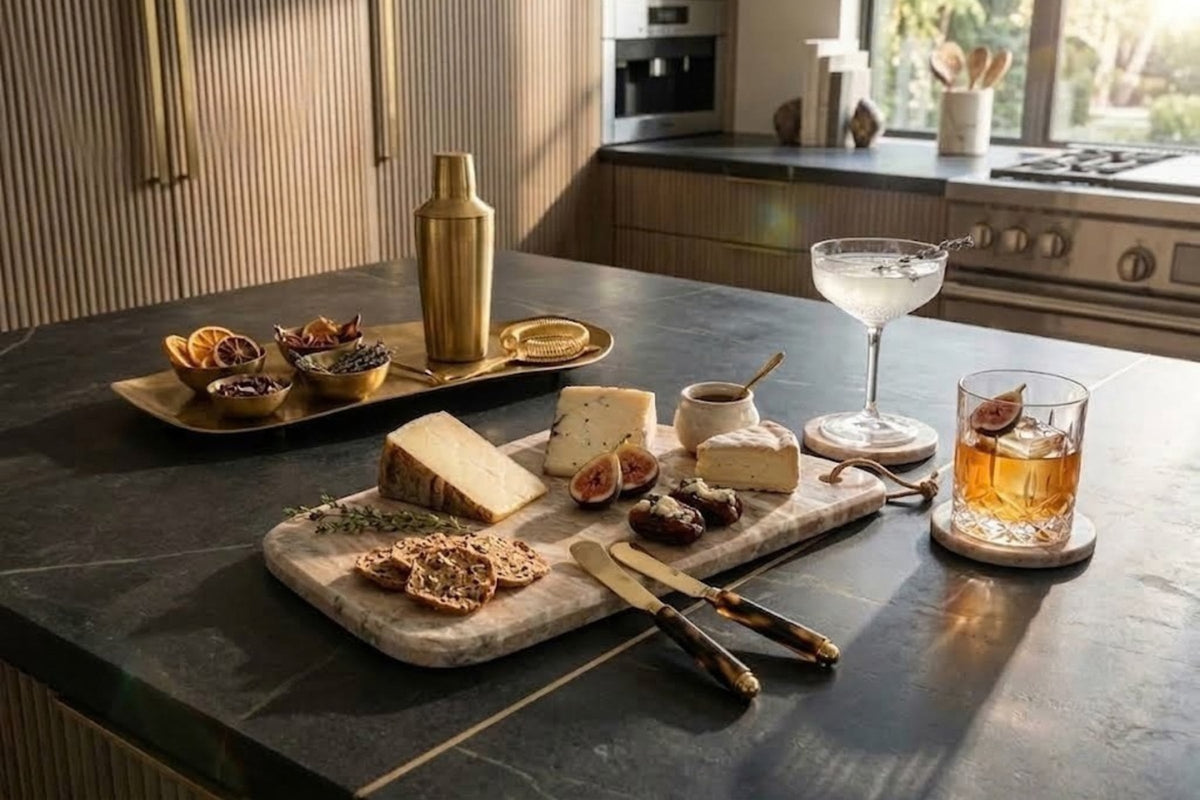
For cheese, charcuterie and anything dry, a solid marble board takes the work directly — the Dakota board, marble cut to an asymmetric outline, or the larger Campania, a white panel within a charcoal surround. Both are stone through, so the surface can be refinished if it ever needs to be.
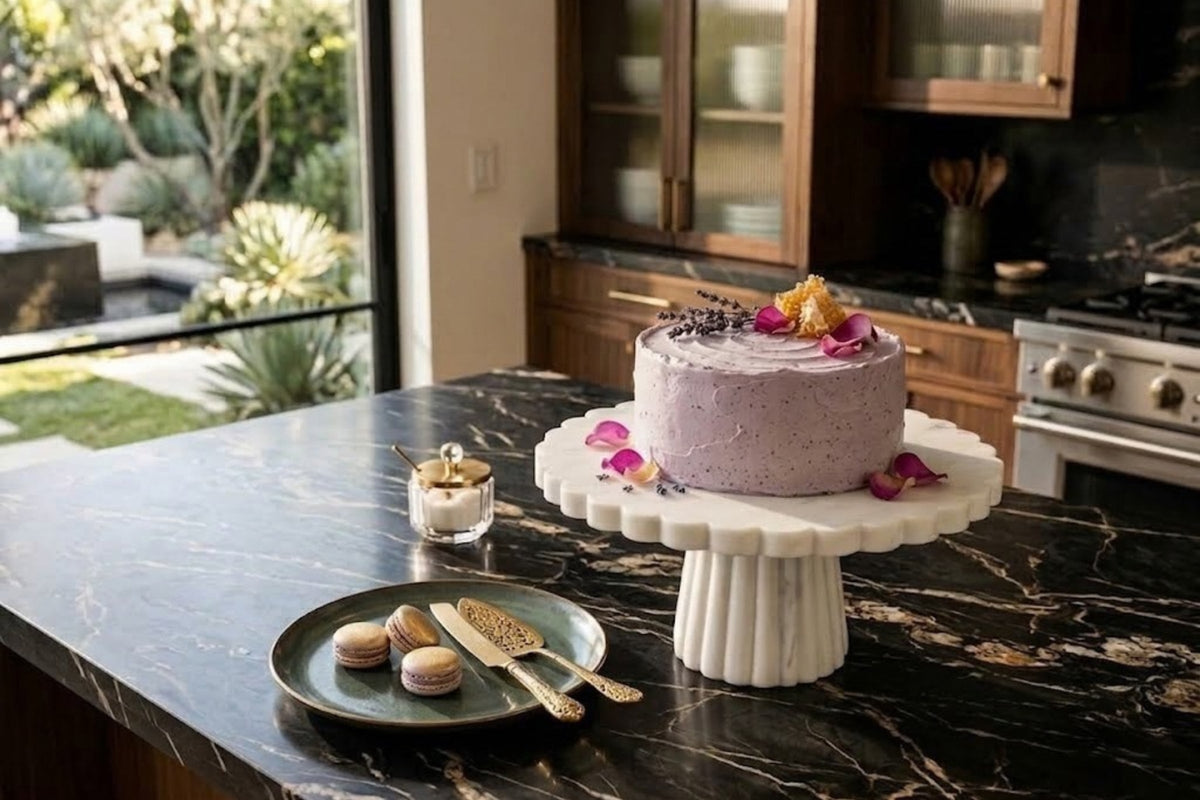
Where a dome is wanted — for pastry, butter, a cut wheel — a scalloped Calacatta viola base under a fluted cloche keeps food covered and off the open surface. For grinding rather than serving, the marble mortar and pestle uses the same density that makes stone worth working on in the first place.
Quick Answers
Is marble safe to eat off?
Yes. Marble is calcium carbonate — inert and non-toxic. Unsealed marble cleans up as well as quartz does, using nothing but ordinary dish soap and water, and bacterial counts on the stone end up no higher than on any other serving surface. Porosity does not translate into bacterial growth.
What is the difference between an etch and a stain on marble?
An etch is chemical erosion caused by acid, leaving a dull mark that cannot be cleaned off because the surface itself has changed. A stain is pigment absorbed into the pores — red wine, oil, turmeric — and can often be drawn back out. The remedy for an etch is refinishing, not scrubbing harder.
Does marble have to be sealed to serve food?
No. Sealing slows staining but is not required for safety, and it does not prevent etching. Etching occurs at the surface, above the pores a sealer fills, so no sealer stops acid reacting with the stone. For a piece handled and washed regularly a sealer is optional; for one used with oil or wine it buys time.
Can you cut cheese directly on a marble board?
Yes, though the stone is softer than the blade — marble is calcite, and a knife will eventually leave fine surface scratches on a polished face. In practice, light serving use marks a honed surface very little. The greater risk to the surface is acidic food left sitting on it.
How do you clean a marble serving board?
Warm water, mild dish soap and a soft cloth, then dry it rather than leaving it to air. Skip the vinegar: it is acetic acid, and on marble it dulls a polished face rather than cleaning it. Isopropyl alcohol is the better choice for sanitizing — it evaporates without residue and does not react with the stone.
Final Note
Marble in a serving context is not a fragile material asking to be spared. It is a reactive one asking to be understood. The dull ring that appears after a lemon has sat too long is not damage in any structural sense — it is calcium carbonate doing what calcium carbonate does.
Pieces used this way accumulate a record of that use. How much that record shows depends largely on the finish chosen at the outset, and how much it matters depends on whether the object was bought to be looked at or to be used.