How to Choose a Cake Stand: Size, Material and Proportion
A cake stand is a proportion problem before it is a material one — get the diameter right and the rest follows
A cake stand should measure roughly two inches wider than the cake it carries. An eight-inch cake sits well on a ten-inch stand; a ten-inch cake wants twelve. That margin leaves the edge of the cake visible and gives a hand somewhere to hold.
Everything after that — height, material, one tier or two — is a question of how the object behaves on the table when nothing is on it. Most cake stands are used a handful of times a year. The ones worth owning are the ones that are not.
What Size Cake Stand Do I Need?
What size cake stand do I need?
Add about two inches to the diameter of the cake. For decorated cakes with detailing at the edge, add the full two inches; for plain sides, a stand matching the cake board will do.
- 6-inch cake — 8-inch stand
- 8-inch cake — 10-inch stand
- 9-inch cake — 11-inch stand
- 10-inch cake — 12-inch stand
- 12-inch cake — 14-inch stand
If you are between sizes, size up. A cake that overhangs its stand reads as a mistake from across a room. A stand with a little rim to spare reads as deliberate.
Why the Two-Inch Margin
Why should a cake stand be wider than the cake?
The margin does three things: it keeps decorated edges from crumbling over the lip, it gives a server room to cut and lift, and it gives the eye a border that separates the cake from the table.
The last of these is the reason a stand exists at all. A cake set directly on a table competes with everything else on the surface. Raised and bordered, it becomes the thing the table is arranged around.
This is the same principle that governs scale in decorative objects — an object needs clearance to read as intentional.

How Tall Should a Cake Stand Be?
How tall should a cake stand be?
Tall enough to lift the cake clear of the table and low enough that a seated guest can see over it. On a dining table, that generally means a shallow pedestal rather than a high one.
Height is where cake stands most often go wrong. A tall pedestal photographs well and blocks conversation. If the stand will sit on a dining table during a meal, keep it low. If it will sit on a console, a sideboard or a kitchen island where nobody is looking across it, height can do more work.
The pedestal also decides whether the object is usable outside dessert. A low stand holds fruit, bread or a stack of small plates. A tall one mostly holds cake.
One Tier or Two?
Should I choose a single or two-tier cake stand?
A single tier suits one cake and stays useful year-round. A two-tier stand suits spreads — pastries, small bites, cheese — and earns its footprint when serving several things at once.
Two tiers solve a table-space problem more than a dessert problem. Where a surface is crowded, a tiered stand takes vertical room instead of horizontal, and separates what would otherwise be one undifferentiated platter.
The trade-off is access. Anything on a lower tier is harder to reach around, so lower tiers work for things guests take by hand rather than things that need cutting.
Marble or Onyx?
Is marble or onyx better for a cake stand?
Marble is the more practical of the two — more even and less expressive, better suited to a piece that is handled and washed. Onyx is more translucent and more variable, which suits a stand that is displayed as much as it is used.
Both are calcium carbonate and both behave similarly under acid. The difference is in how they carry light. Marble is translucent too, but less so than onyx, so the light stays close to the surface; in onyx it travels further into the stone, and the tier reads differently depending on where the light is coming from.
The fuller comparison between marble and onyx covers where each material belongs across the home. For a stand specifically: marble if it will be used often, onyx if it will be seen often.

Is a Cake Stand Food Safe?
Is a marble cake stand safe for food?
Yes. Marble is calcium carbonate — inert and non-toxic — and it cleans to food-safe standards without sealing. The consideration is acid, not safety.
Cake is largely benign on stone. Buttercream, sponge, chocolate and pastry sit on marble without reacting. What does react is citrus — a lemon tart, a cut fruit garnish, a glaze with lemon juice in it — which will etch the surface if left sitting.
The full explanation of why, and the distinction between an etch and a stain, is set out in is marble safe for serving food.
Weight and Stability
Does a cake stand need to be heavy?
It needs a base wide enough and heavy enough that the loaded stand cannot be tipped by a serving knife. Weight in the base does that work; weight in the plate does not.
Cutting a cake applies sideways force. A stand with a narrow foot and a broad top will rock under it. This is where stone earns its place over lighter materials — the mass sits low, and the object stays where it is put.
Brass stems behave the same way when the base is properly proportioned, adding lift without raising the center of gravity.

Using a Cake Stand the Rest of the Year
What else can a cake stand be used for?
Fruit, bread, a stack of side plates, soap and a folded cloth in a bathroom, or nothing at all — a low stone stand works as a riser for other objects.
This is the argument for buying one stand well rather than several occasionally. A stand chosen only for a birthday spends the year in a cupboard. A low marble pedestal on a kitchen counter holding fruit is in use every day and becomes cake-adjacent twice a year.
It is the same logic behind choosing serveware for everyday use: an object that only performs on occasions is an object mostly in storage.
Which Stand for Which Use
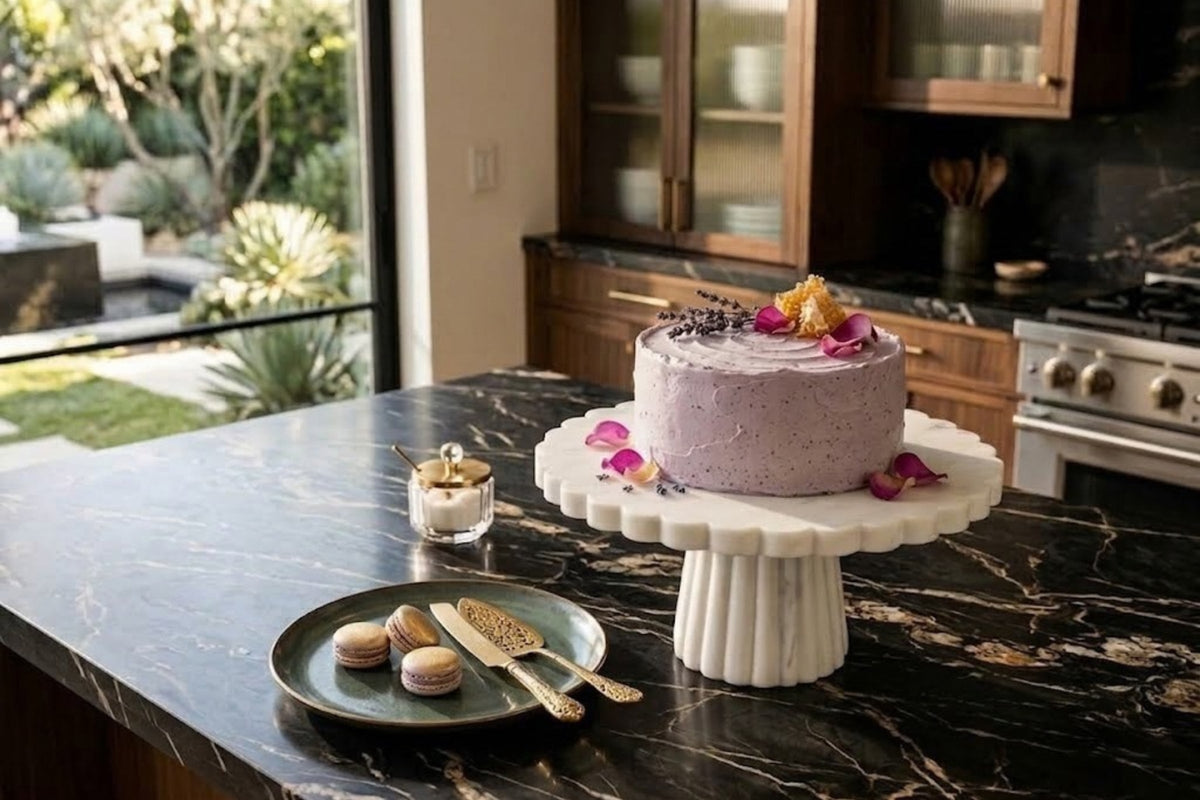
For a single cake and daily use in between, the Bobby stand — honed white marble, scalloped rim on a fluted pedestal is the straightforward choice. Honed rather than polished means etching has less to contrast against.
For spreads, the Concorde, black marble in two lobed tiers on a brass stem, or the Heavenly, brown onyx tiers graduated on a slender brass rod. Either pairs with the Imperial servers in brushed gold.
Quick Answers
What size cake stand do I need for an 8-inch cake?
A 10-inch stand. Add about two inches to the cake's diameter and the rest follows: a 6-inch cake wants 8, a 9-inch wants 11, a 12-inch wants 14. That margin keeps decorated edges clear of the lip and leaves room to cut and lift a slice cleanly. Between sizes, size up.
How tall should a cake stand be?
Low enough for seated guests to see over it on a dining table, which usually means a shallow pedestal. A tall pedestal photographs well and blocks the conversation across it. Height is fine on a console or island, where nobody is looking across the surface, and a low stand doubles for fruit and bread.
Is a marble cake stand food safe?
Yes. Marble is calcium carbonate — inert and non-toxic — and it cleans to food-safe standards without sealing. Buttercream, sponge, chocolate and pastry are all benign on stone. Citrus is the one to watch: a lemon glaze or a cut-fruit garnish left sitting will etch the surface, though it poses no safety issue.
Should a cake stand be marble or onyx?
Marble reads more even and less expressive, which suits a stand handled and washed regularly. Onyx is translucent and more variable, better suited to one displayed as much as used. Both are calcium carbonate and both behave the same way under acid, so the real choice is what each does with light.
Can a cake stand be used for anything besides cake?
Yes. A low stone stand works for fruit, bread, side plates, soap and a folded cloth in a bathroom, or simply as a riser that lifts another object. Choosing one that functions year-round is the difference between an object in use and an object that comes out twice a year.
Final Note
The cake is on the stand for perhaps an hour. The stand is in the house for years. Choosing for that hour alone is how households end up with tall, ornate pedestals that come out twice a year and take up shelf space the rest of the time.
A stand sized correctly, kept low, and cut from a material worth looking at empty does the same work for the cake and then goes on doing work afterwards. For arrangement once it is on the table, see how to style a cake stand.