How to Choose Bookends That Hold Books
There are two kinds of bookend, working by opposite principles — and most disappointment comes from buying one and expecting the other
A bookend either borrows weight from the books or supplies its own. The first kind slides a thin foot underneath the stack, so the books press down on it and anchor it in place. The second kind is a solid block that stays put because it is heavy enough not to move.
Stone bookends are the second kind. That makes them dependent on three things the first kind can ignore: mass, base friction, and height. Get those right and a pair holds a shelf indefinitely. Get them wrong and you have two objects sitting next to a row of leaning books.
The Two Ways a Bookend Works
How do bookends actually work?
One design uses leverage: a flat foot slides beneath the books so their own weight clamps the upright face against the last spine. The other uses mass: the object is heavy enough that friction against the shelf resists the books pushing outward.
The leverage design is the thin sheet-metal bracket found in libraries, where the weight of the books themselves holds the foot down. Its advantage is that it grows stronger as the shelf fills — more books mean more downward force on the foot.
The mass design is older and simpler, and covers most bookends made from wood, bronze, marble and onyx. It has no foot to slide under anything. It holds because it is heavy and because its base grips the surface it sits on.
Do Bookends Need to Be Heavy?
How heavy should a bookend be?
A solid bookend needs enough mass that the sideways force of leaning books cannot overcome the friction between its base and the shelf. In practice that means stone, metal or dense hardwood — not hollow forms or light composites.
The force involved is smaller than people assume. Books do not push hard; they lean. What defeats a light bookend is not a sudden load but a slow one, applied constantly, on a surface with very little grip.
This is where stone does work that lighter materials cannot. A solid block of marble or onyx carries its mass low and does not need to be anchored to anything. It is the same property that makes weight and scale matter across other objects on a shelf.

How Tall Should a Bookend Be?
How tall does a bookend need to be?
Tall enough to bear against the spines above their midpoint. A bookend that only reaches a third of the way up a row acts as a pivot rather than a support — the books tip over the top of it.
This is the most common sizing error. A low, wide bookend looks correct on a shelf and fails against tall hardbacks, because the contact point sits below the center of gravity of the books it is meant to hold.
Match the height to the books you actually own. A shelf of paperbacks and a shelf of art books are different problems, and one pair of bookends will not solve both.
Why Bookends Slide
Why do my bookends slide across the shelf?
Because the base is smooth and the shelf is smooth. Friction, not weight alone, is what holds a solid bookend in position — and a polished stone base on a lacquered shelf has very little of it.
A flat, honed base grips better than a polished one. Glass and high-gloss shelving are the hardest surfaces to hold on; painted timber and open-grain wood are the easiest.
If a pair still creeps, a thin felt pad on each base solves it without adding weight. The problem is almost never the mass of the object.
Marble or Onyx?
Should bookends be marble or onyx?
Both carry sufficient mass. Marble is more even in tone; onyx is more translucent and more variable, reading with more depth on a lit shelf. For function they are equivalent — the choice is what the shelf should look like.
Onyx does something on a bookshelf that marble does not. Where a shelf is lit from above or sits near a window, light enters the stone at the edges and the object appears to hold light rather than reflect it. The fuller comparison between the two covers where each belongs across the home.
Because both are cut from natural blocks, a pair will not match exactly. Variation between the two halves is inherent to the material, not a defect in the pair.

How Many Books Will a Pair Hold?
How many books can bookends hold?
Fewer than most people expect, and the number matters less than the arrangement. A tightly packed row needs no bookends at all. A half-empty shelf needs them most, and that is also the hardest case.
The honest answer is that a solid pair holds a row that leans, not a row that has collapsed. If books are already falling at an angle, the load is beyond what friction against a shelf will resist, and the fix is a fuller shelf or a divider rather than a heavier object.
Used as intended — anchoring both ends of a partly filled row of ordinary books — stone bookends hold indefinitely and never need adjusting.
Using Bookends Without Books
Can bookends be used as decorative objects?
Yes, and a well-cut pair often works better that way. Two matched forms at either end of a shelf give a composition its outer boundary, whether or not anything sits between them.
A pair separated across two shelves reads differently again — as two related objects rather than a set performing a task. This is a useful move where a shelf holds objects rather than books.
The principles are the same ones that govern styling open shelves and scale in decorative objects: the object needs clearance around it to read as deliberate.
Two Pairs, Two Uses
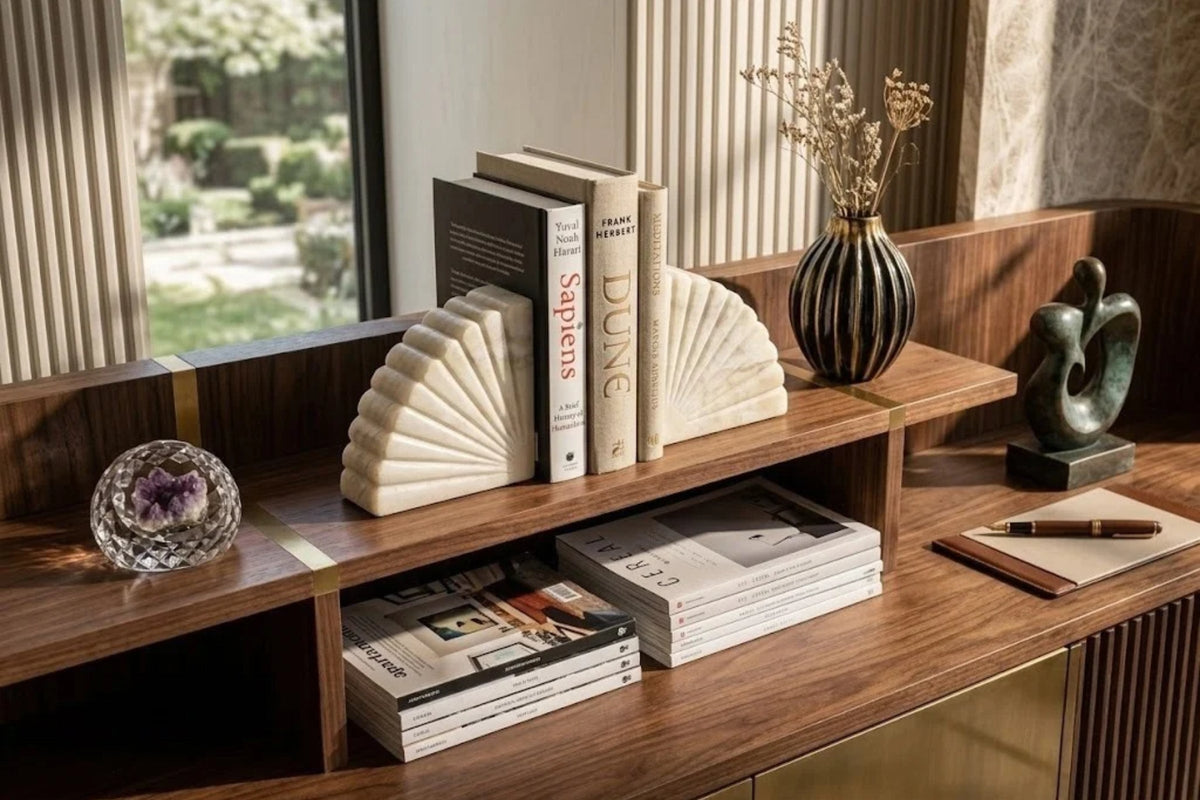
The Emrys pair — ivory onyx, stepped ridges fanning from base to arc is cut from single blocks with a honed finish and a flat back, which is the surface that does the work against the spines. The honed base also grips a shelf better than a polished one would.
The Enchant pair — marble arches with a gold starburst set flush sits lower and wider, which suits shorter rows and paperbacks rather than tall hardbacks. Both hold their position on a desk with no books at all.
Stone bookends need no particular maintenance beyond what any stone object needs — the marble and onyx care notes cover it.
Quick Answers
How do bookends work?
Two ways. A bracket design slides a foot under the books so their weight clamps it in place. A solid design holds by its own mass and the friction of its base against the shelf. Stone bookends are the second kind.
How tall should a bookend be?
It should reach above the midpoint of the books it supports. A bookend shorter than that acts as a pivot rather than a support, and tall hardbacks will tip over the top of it regardless of how heavy it is.
Why do bookends slide across a shelf?
Because friction, not weight alone, holds a solid bookend in place. A polished base on a glossy or glass shelf has very little grip, while painted timber and open-grain wood are the easiest to hold on. A honed base helps, and a thin felt pad under each one solves it entirely.
Are marble or onyx bookends better?
Functionally they are equivalent — both carry ample mass. Marble is more even in tone; onyx is more translucent and more variable, and where a shelf is lit or sits near a window, light enters onyx at the edges so it appears to hold light rather than reflect it. The choice is visual, not practical.
Do bookends need to match each other exactly?
Stone pairs will not match exactly, because each half is cut from a natural block with its own veining. That variation is inherent to the material rather than a flaw, and it is what distinguishes stone from a molded pair.
Final Note
A bookend is one of the few objects in a house whose success is measurable. Either the books stand or they do not. That makes it unusually easy to buy well, provided the question asked at the point of purchase is about mass, height and base rather than about how the object looks on a shelf photographed empty.
The pairs worth owning satisfy both. They hold a row of books without being thought about, and when the row is removed they remain worth looking at — which is the argument for cutting them from a material that has something to say on its own.