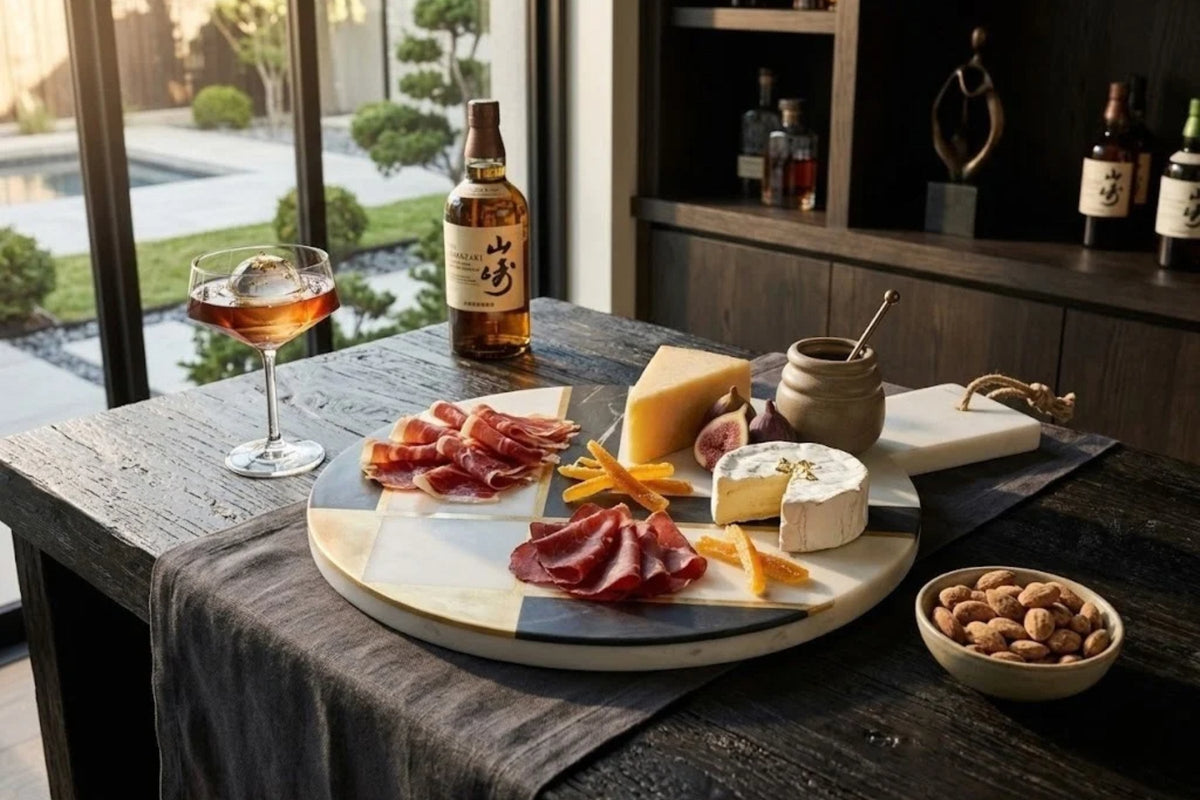
How to Choose a Cheese Board: Size, Material and Shape
Board size is not really a question about boards — it is a question about whether cheese is the first course or the whole meal
As a starter before dinner, plan on one to one and three-quarter ounces of cheese per person. As the meal itself, plan on seven to eight. That is roughly a fivefold difference, and it is the single fact that decides what size board you need.
Most people oversize the starter board and undersize the one that has to carry a meal. Work from the arithmetic first; shape, stone and finish are the easier decisions and come after.
How Much Cheese Per Person?
How much cheese do you need per person?
One to one and three-quarter ounces per person when cheese precedes a meal. Seven to eight ounces per person when cheese is the meal. For a full spread with bread and accompaniments, plan on roughly double the cheese weight again in everything else.
Run the numbers for six guests and the difference becomes concrete. As a starter, six people need around nine ounces of cheese in total — spread across three varieties, that is three ounces of each. Three small wedges.
As the meal, the same six people need closer to forty-five ounces. Nearly three pounds. That is not the same object, and no single modest board carries it comfortably.
What Size Board Do I Need?
What size cheese board should I buy?
For cheese as a starter, a board that holds three wedges with a hand's width of clear space around each is sufficient for six to eight people. For cheese as a meal, size up substantially or plan on two boards.
The constraint is not the volume of cheese. Three ounces of cheese takes very little room. The constraint is separation — cheeses need space between them so flavors do not transfer, knives do not cross, and a soft cheese does not slump into a hard one.
Allow room around the perimeter for accompaniments as well. Crackers, dried fruit and cured meats take up more of a board than the cheese does, and crowding them against the wedges is what makes a board look full rather than composed.
How Many Cheeses Should Be on a Board?
How many cheeses should go on one board?
Three is enough for most gatherings. Choose across textures rather than across flavors — something soft, something firm, something hard — so guests encounter contrast rather than three variations on the same thing.
Adding varieties past three tends to reduce each portion to a sliver and makes the board harder to read. It also multiplies the knife problem: every soft cheese needs its own blade.
Where the board is the meal rather than the opening, more varieties make sense, because the quantity per variety stays substantial.

Round, Rectangular or Freeform?
What shape cheese board works better?
Round boards suit a table where guests sit around them and reach from any side. Rectangular boards suit a counter or a long table where people move along the length of the spread. Freeform boards suit a single cheese presented as an object.
Shape follows the room more than the food. A round board in the middle of a dining table gives every seat equal access. The same board on a kitchen island against a wall wastes half its surface, because nobody reaches the far side.
Rectangular boards also sequence better — mild to strong, left to right — which a circle cannot do.
Marble, Onyx or Semi-Precious Stone?
Which stone works better for a cheese board?
Marble is the practical default — dense, even, and cool enough to keep soft cheese firm longer than wood does. Onyx and semi-precious stone read with more depth and suit boards that are presented rather than worked on.
The thermal property is a real advantage, not a marketing one. Stone gives up its coolness slowly, which holds a brie or a washed rind in better condition across an evening than a warmer surface would.
The finish matters as much as the stone. A honed surface conceals marks better than a polished one — the difference between the two finishes shows most clearly on a board that gets used.
Can You Cut Directly on Stone?
Can you cut cheese directly on a marble board?
Yes. The stone is softer than the blade — marble is calcite, and a knife will eventually leave fine surface scratches on a polished face. In practice, light serving use marks a honed surface very little. The greater risk to the surface is acid — citrus, wine and vinegar left sitting will etch it.
This is the trade specific to stone. It takes ordinary serving use with very little to show for it, and it is vulnerable to something wood is not. A fig or a hard cheese leaves nothing behind. A cut lemon left across an evening leaves a dull ring.
The full explanation — including why an etch is not a stain and cannot be cleaned off — is in is marble safe for serving food.

What About the Knives?
How many cheese knives do you need?
One per cheese, at minimum, so flavors do not transfer. A set of three covers the standard soft, firm and hard division that a three-cheese board is built around.
The shapes are functional rather than decorative. An open or skeletonized blade releases soft cheese instead of dragging it; a narrow pointed blade breaks hard cheese along its grain; a flat blade slices firm cheese cleanly.
Handles matter more on a stone board than a wooden one, because the board itself gives no grip — a knife set down on polished marble slides.
Choosing a Board
For a starter board that also earns its place the rest of the year, the Dakota — marble cut to an asymmetric outline with a leather cord works as a serving surface and as an object left out. The larger Campania, a white panel within a charcoal marble surround takes a three-cheese spread with room to spare.
Where the board is presented rather than worked on, the Brno joins Verde Guatemala, Himalayan Green and green onyx in brass inlay, and the Dazzle is cut in amethyst, rose quartz or aventurine with a freeform edge. Pair either with carved ivory resin knives.
On keeping a board in condition over years, see caring for trays and serveware and choosing serveware for everyday use.
Quick Answers
How much cheese do I need per person?
One to one and three-quarter ounces per person if cheese comes before a meal, and seven to eight ounces if cheese is the meal — roughly a fivefold difference. Six guests as a starter need about nine ounces in total. The same six as a main course need nearly three pounds.
What size cheese board do I need?
For a starter, a board holding three wedges with a hand's width of clearance around each serves six to eight. The constraint is separation rather than volume — flavors transfer, knives cross, and a soft cheese slumps into a hard one. Leave perimeter room too: crackers and cured meats take more space than the cheese does.
How many cheeses should be on a board?
Three is enough for most gatherings, chosen across textures rather than flavors — one soft, one firm, one hard. Past three, each portion falls to a sliver, the board becomes harder to read, and every soft cheese wants its own blade. More varieties are justified only when the board is the meal.
Can you cut cheese directly on a marble board?
Yes. The stone is softer than the blade — marble is calcite, and a knife will eventually leave fine surface scratches on a polished face. In practice, light serving use marks a honed surface very little. The greater risk to the surface is acidic food left sitting on it, such as citrus or wine, which etches rather than stains.
Is a round or rectangular cheese board better?
Round suits a table where guests reach from every side; set against a wall it wastes half its surface. Rectangular suits a counter or long table where people move along the spread, and it allows cheeses to be sequenced from mild to strong, which a circle cannot do. Freeform suits a single cheese presented alone.
Final Note
A cheese board is one of the few serving objects where getting the quantity right matters more than getting the object right. Nine ounces of cheese on a generous surface reads as considered. The same nine ounces crowded onto something too small reads as an afterthought, whatever the board is cut from.
Stone is worth choosing here for a reason beyond appearance: it holds temperature, it takes ordinary serving use with very little to show for it, and it looks like something when the food has gone. A board that has to be put away between uses is a board that mostly lives in a cupboard.