How to Choose a Mortar and Pestle: Size, Weight and Stone
A mortar is sized by the volume of the bowl and steadied by the weight of the block — footprint is the last thing to look at.
For most kitchen work the useful range is a bowl holding between 1.5 and 4 cups, with an interior 3 to 5 inches across, in a mortar weighing at least five pounds. That is wide enough to spread spices in a single layer, deep enough that ingredients do not climb out, and heavy enough to stay put while the pestle works.
The second decision is the stone, and it is not the same question as which stone is harder. Granite and marble grind differently because their minerals differ, and the difference shows up in what each one is good at rather than in which one lasts longer. Both outlive the kitchen they are bought for.
What Size Mortar and Pestle Do I Need?
How large should the bowl be?
Between 1.5 and 4 cups of capacity, with a wide, flat interior of 3 to 5 inches. America's Test Kitchen found that range gave enough room for pesto, curry paste, salsa and spice blends without ingredients escaping the bowl.
Interior width matters more than depth for anything dry. Spread across a flat base in a single layer, peppercorns and coriander seed break under the pestle. Heaped in a narrow well, they roll around one another and stay whole.
The pestle has its own dimensions. Around a pound in weight does the work without tiring the hand, and a shaft long enough to clear the rim keeps the knuckles out of the bowl. A pestle whose head reaches the full floor of the mortar is doing its job; one that bridges a curve leaves a ring of unground material where the wall meets the base.
Why Weight Is the Working Part
How heavy should a mortar be?
At least five pounds. Below that the bowl travels under the pestle and has to be held in place rather than worked in, which turns a two-handed tool into a wrestling match.
Stone reaches that weight without becoming large. Marble supplied to ASTM C503 must meet a minimum density of 162 pounds per cubic foot — 2,595 kg/m³, roughly two and a half times the density of water — so a compact block sits with real authority on a counter. The same specification sets a minimum compressive strength of 7,500 psi, which is the number that matters when a pound of stone is being driven repeatedly into a bowl.
This is the same density that makes stone worth working on generally, and the reason it appears across the serving pieces in the kitchen rather than only in the tools. Our note on choosing serveware for everyday use covers where that mass helps and where it simply adds to what has to be carried.

Why Crushing Is Not Chopping
Why use a mortar instead of a blender?
Because crushing ruptures cell walls and a blade cuts past them. Plant tissue holds its aromatics inside rigid structures; pressure breaks those structures open, while a thin blade slices between them and leaves much of the flavor where it was.
The second difference is heat. A powered blade generates friction, and friction drives off the volatile compounds that make fresh herbs taste fresh. A pestle moves only as fast as a hand can move it, so nothing warms. Side-by-side pesto tests have found the hand-crushed version brighter in both color and flavor.
Emulsion is the third. Garlic, salt and oil worked together in a bowl combine into a paste that holds; the same ingredients chopped and stirred separate. This is why aioli, pesto and curry pastes are the tasks a mortar keeps, long after a processor has taken over everything else.
Marble or Granite?
Is marble or granite better for a mortar and pestle?
They behave differently. Granite is quartz and feldspar — Mohs 7 and 6 — so its interior stays coarse and bites hard, dry spices quickly. Marble is calcite, Mohs 3: finer, less abrasive, and better suited to herbs, garlic and anything that should finish as a paste.
Hardness is often read as a quality ranking. It is not. It describes what a surface does to what is placed on it. A coarse, abrasive interior shreds; a finer one presses and smears. Smooth metal and glazed stoneware fail at both, because they give the ingredients no traction at all and everything simply slides.
Marble's tighter grain has a second consequence. Under ASTM C503 it absorbs no more than 0.20 percent of its weight in water, so it takes up less of what is ground in it than a more open stone would. Turmeric and chili still leave color over time. Veining means no two mortars read alike, which is the nature of natural stone rather than a variation in grade.
Smooth Bowl or Textured Bowl
Should the inside of a mortar be rough?
It depends on the technique. A textured interior grinds on a rotating stroke. A smooth interior works on a pounding stroke, where the force comes downward and the bowl's job is to contain rather than to abrade.
Neither is wrong, but they suit different hands and different recipes. Dry whole spices reduce fastest against texture. Wet pastes, soft herbs and garlic release well under a pounding stroke and clean far more easily out of a smooth bowl afterwards.
Exterior finish is a separate matter from interior finish, and the two are often deliberately different — carved or faceted outside for grip, unbroken curve inside for the work. The distinction between honed and polished applies to each face independently.
Seasoning and First Use
Do you need to season a new mortar and pestle?
Yes, if it is stone. A new bowl sheds loose particles, and those particles end up in the first thing ground in it.
The established method is rice. America's Test Kitchen ground three tablespoons of raw white rice for around eight minutes, discarded the powder, and repeated the cycle three times in total — until the flour that came out was as white as the output of an electric grinder, with no gray cast of stone dust. They confirmed the result by making guacamole in the seasoned bowl and finding it free of grit.
Some cooks follow the rice with a pounding of garlic, salt and cumin and leave it overnight before rinsing. That step is about scent rather than grit. It is optional; the rice is not.
Acid, Stains and Cleaning
How do you clean a marble mortar?
Warm water, a soft brush, and a thorough dry with a cloth. Do not leave it to soak, and do not reach for the lemon.
The lemon-and-salt trick circulates widely as a way to deodorize a stone bowl, and on granite it is harmless. On marble it is the one thing to avoid. Marble is calcium carbonate, citric acid dissolves calcium carbonate, and the result is a dull etched patch where the polish used to be. The chemistry is covered at length in our piece on whether marble is safe for serving food, and the distinction between an etch and a stain is worth understanding before any cleaning decision.
For lingering odor, grind a spoonful of raw rice or coarse salt and discard it. For color left by turmeric or chili, time does more than scrubbing. General guidance for stone in the kitchen sits in our marble and onyx care notes.
Choosing a Piece
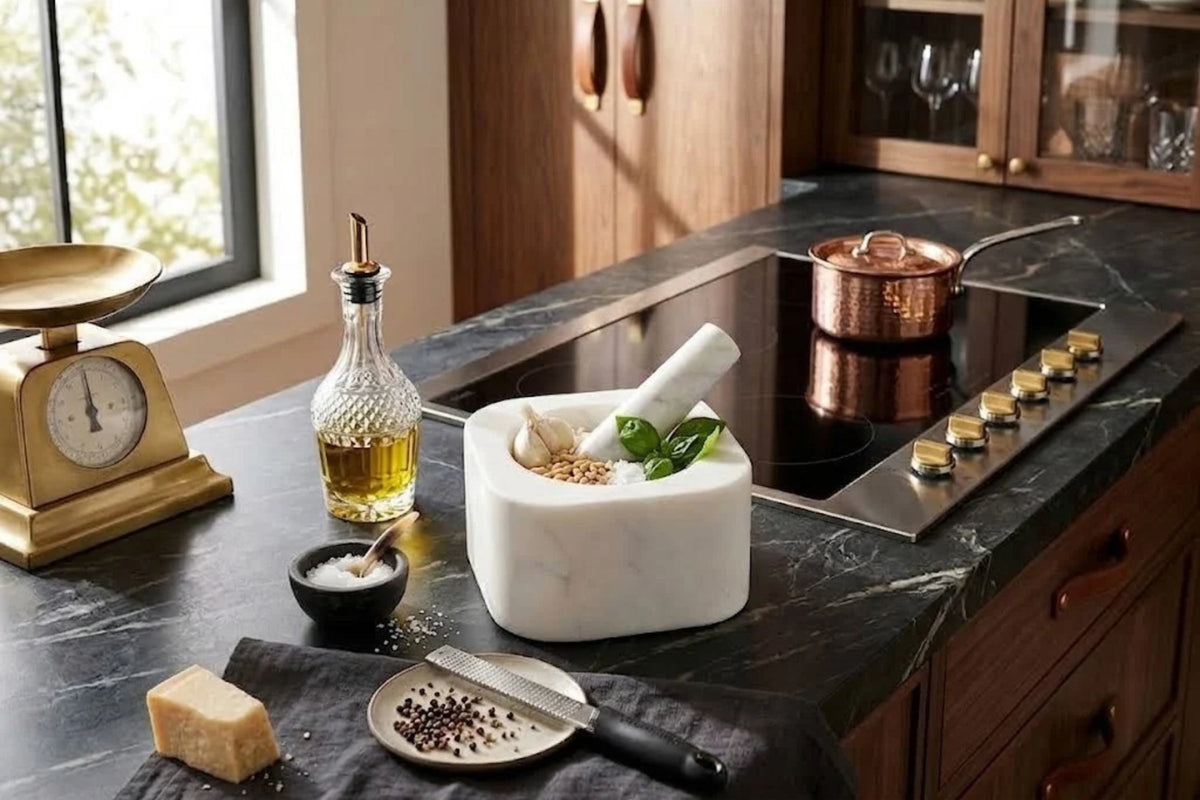
Where the mortar is going to sit out, the form matters as much as the bowl. A single block of white marble with the bowl cut deep into it reads as one mass rather than as a bowl on a base, and the pestle's rounded head reaches the full floor. Where grip is the priority, a mortar faceted in deep diamond relief with a smooth interior gives one hand something to hold while the other works.
For spices that are ground at the table rather than in advance, Terra Bianco marble mills carved in raised and recessed bands take over where the mortar stops.
Quick Answers
What size mortar and pestle do I need?
For most kitchen work, a bowl holding between 1.5 and 4 cups, with an interior 3 to 5 inches across. That range takes pesto, curry paste and spice blends without ingredients climbing the walls. Anything smaller is a spice grinder; anything larger is difficult to lift and store.
How heavy should a mortar be?
At least five pounds. A lighter bowl slides under the pestle and has to be held rather than worked. Marble carries that weight in a modest footprint: ASTM C503 sets a minimum density of 162 pounds per cubic foot, roughly two and a half times the density of water.
Is marble or granite better for a mortar and pestle?
They work differently. Granite is quartz and feldspar, Mohs 6 to 7, so its interior stays coarse and bites hard spices quickly. Marble is calcite, Mohs 3, finer and less abrasive — slower on peppercorns, better on herbs, garlic and anything that should end as a paste.
Do you need to season a new mortar and pestle?
Yes, if it is stone. New bowls shed loose grit. America's Test Kitchen grinds three tablespoons of raw white rice for about eight minutes, discards the powder and repeats twice more, until what comes out is white and free of stone dust. Rinse and dry afterwards.
How do you clean a marble mortar?
Warm water, a soft brush, and a thorough dry with a cloth. Do not soak it. Skip the lemon-and-salt trick that circulates for stone bowls: marble is calcium carbonate, and citric acid etches it. For odor, grind a spoonful of rice or coarse salt and discard it.
Final Note
A mortar is one of the oldest tools in a kitchen and one of the few that has not been improved on. Nothing electric produces the same paste, because nothing electric applies pressure without also applying heat. The tool survives because the physics has not changed.
Chosen at the right weight and the right capacity, it stops being a specialist object and becomes the thing reached for first. Chosen too small or too light, it stays in the cupboard. The difference is a few inches of interior and about four pounds of stone.