How to Choose Candle Holders for Taper Candles: Fit, Height and Stability
A taper holder is settled by one measurement before anything else: the opening has to match the base of the candle.
The standard taper sold in the United States has a base diameter of 7/8 inch — 2.2 cm — and most candlestick holders are bored to receive it. Thin tapers run to 1/2 inch, and the slender celebration tapers narrower still, at roughly 1/4 inch. A holder and a candle that disagree on this number will either rattle or refuse to seat.
Everything after fit is a question of height, mass and placement. Height decides whether a flame clears a sightline across a table. Mass decides whether a knocked holder moves. Bore, height and weight are what separate a holder that works from one that only photographs.
What Size Taper Candle Holder Do I Need?
What size opening does a taper candle holder need?
Seven-eighths of an inch, for the standard taper. That figure comes from the dipping convention itself — a classic taper is built up over successive dips to a 7/8 inch diameter — and holders are bored to match.
The two common failures are opposites. A cup bored wider than the candle lets the taper lean, and a leaning taper burns down one side and drips. A cup bored narrower will not take the candle without force, which on stone puts the rim at risk rather than the wax.
The remedy for a taper fractionally too wide is warmth, not a blade. Hold the base in the hand for a minute until the wax softens, then seat it. Trimming with a knife tends to leave a base that is off-center, and an off-center taper leans for the whole of its burn.
How Tall Should a Taper Holder Be?
What height works on a dining table?
Either below the sightline or well above it. A flame sitting at eye height across a table is the one placement that interrupts a conversation rather than lighting it.
Taper lengths cluster at four sizes: 6 inch for compact arrangements, 10 inch as the common dinner length, 12 inch for more formal settings, and 18 inch where height is the point. Burn time follows length closely, at a little under an hour per inch, so a 10 inch taper gives roughly nine hours and a 12 inch roughly eleven.
Holders sold in pairs are often deliberately mismatched in height, and the reason is optical. Two flames at the same level read as a flat line; two at different levels read as a composition. The same logic governs objects generally, and is covered in our note on balance through height and scale. On a table that is in daily use, the holders have to earn their footprint alongside everything else — see styling a dining table for everyday use.
Why Weight Matters More Than It Looks
Why do stone candle holders feel so heavy?
Because solid stone is dense — around two and a half times the weight of the same volume of water. A small form carries real mass, and that mass sits low, which is exactly where a candlestick needs it.
That mass is functional rather than decorative. A lit taper puts its weight and its flame at the top of a lever, and the base is what resists a knock. A heavy foot in a narrow footprint is the most useful thing a candlestick can have.
Metal holders reach stability by a different route. A drawn or spun metal form is a shell, so its steadiness comes from wall thickness and the width of the foot rather than from the density of the material. Both approaches work. It is worth knowing which one an object is using before placing it somewhere it can be caught by a sleeve.

Where a Lit Candle Can Sit
How much clearance does a lit candle need?
Twelve inches from anything that can burn. At a table that means the linen and the flowers as much as the curtains.
The number is worth taking seriously because proximity, not the candle, is usually what goes wrong. Most candle fires start with something combustible sitting too close to the flame, and most of the rest with a candle left alone in the room.
This is where the holder does quiet work. A wide, heavy foot keeps the flame where it was put. A tray underneath gives it defined territory and keeps the paper and the linen off. Neither is a safety device. Both make the careless version of an evening less likely.
Drafts, and When Glass Earns Its Place
What stops a taper from guttering?
A shield. A bare taper in moving air burns unevenly, drips down the lee side and shortens its own life. A hurricane places a glass cylinder around the flame and removes the problem entirely.
This is the one case where a second material is doing work rather than adding ornament. The stone base holds the candle and the weight; the glass holds the air still. On a console near a door, or anywhere a room moves, the difference is immediate.
Where air is still, an open holder is the better object — the flame is visible from every angle and nothing sits between it and the room.
Wax, Stone and Cleaning
Does candle wax damage marble or onyx?
No. Marble is dense enough that very little is taken into it — wax sits on the surface rather than soaking in, and lifts away once cold.
The method matters more than the timing. Let the wax harden completely, then push it off with a fingernail or a plastic edge. Marble is calcite, softer than hardened steel, so a metal blade will mark the stone long before it helps with the wax.
A chiseled or grooved surface handles drips better than a smooth one, because the wax collects in the recesses and releases in pieces instead of smearing across a polished face. Finish is doing the work here, and the difference between honed and polished shows up in exactly this kind of use. Fuller cleaning guidance sits in our marble and onyx care notes.
Choosing Between Materials
In stone, the choice is largely about how the material meets light. Both are translucent, and the difference is one of degree: light enters marble and returns close to the face, while in onyx — more visibly banded as well — it travels further, so a flame behind it moves through the stone rather than off it. Neither is more correct — they produce different rooms.
Veining and banding vary block to block, so a pair of stone holders will never be identical to each other, let alone to a photograph. That is the nature of natural stone rather than a defect in a particular piece.
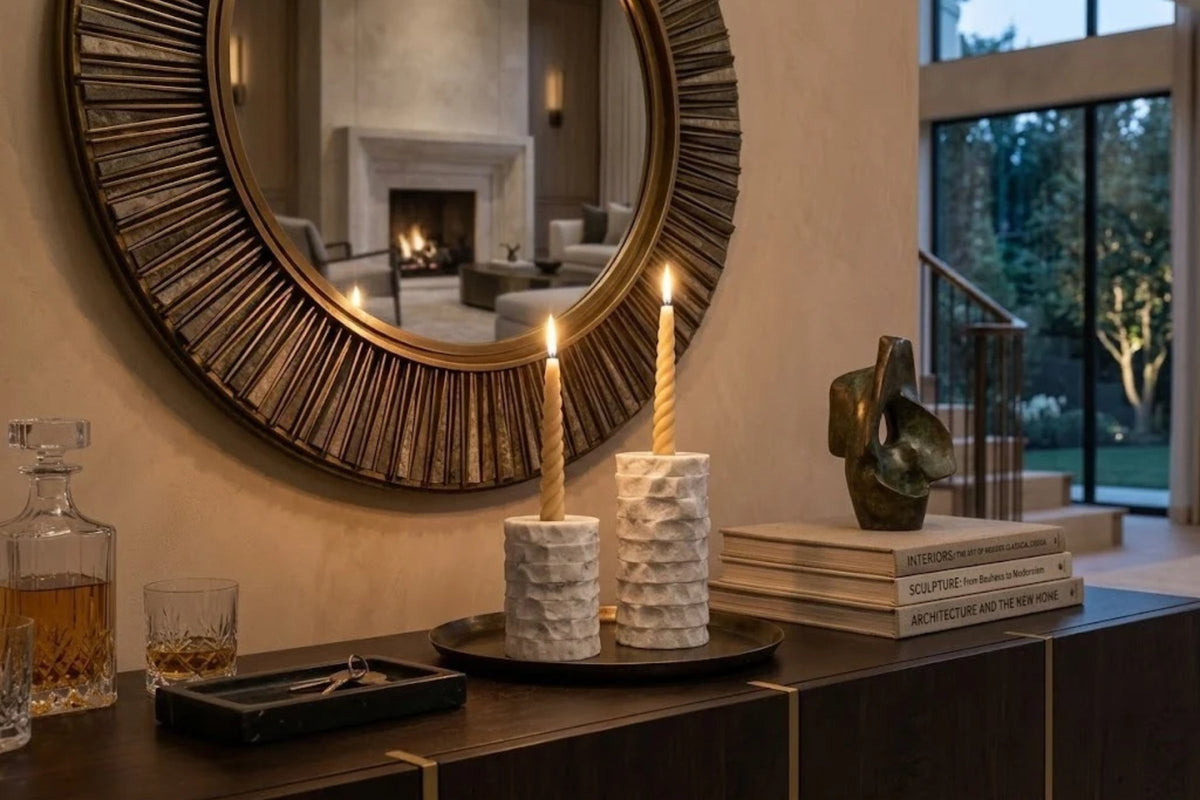
For a sculpted stone pair, the Flores holders, white marble chiseled in rough-hewn bands, put texture where the wax lands. Where a flame needs shelter, the Estonia hurricane, a two-tier stone base under clear glass, is the piece built for it. In metal, the Twilight holders, brushed satin gold in a rope twist, break the light into a rising line rather than one continuous gleam.
Quick Answers
What size taper candle holder do I need?
Most holders are bored for the standard taper, which has a base diameter of 7/8 inch, or 2.2 cm. Thin tapers measure 1/2 inch and need a narrower cup. If a candle is fractionally too wide, warm its base in the hand until the wax softens rather than trimming it.
How tall should taper candle holders be on a dining table?
Low enough that the flame sits below eye level across the table, or tall enough to clear it entirely. A 10 inch taper is the common dinner length and burns roughly nine hours; a 12 inch reads more formal. Pairs at differing heights avoid one flat line of light.
How much clearance does a lit candle need?
Twelve inches from anything that can burn — linen, flowers, paper and curtains alike. Proximity is what usually goes wrong rather than the candle itself: most candle fires start with something combustible sitting too close to the flame, and most of the remainder with a candle left burning in an empty room.
Why does a taper drip down one side?
A taper drips down one side when it burns unevenly, and that happens for two reasons: the holder is bored wider than the candle so the taper leans, or moving air pulls the flame across. A well-fitted holder solves the first; a glass hurricane solves the second.
Does candle wax damage a marble holder?
No. Marble absorbs very little, so wax sits on the surface rather than soaking in and lifts away once it has gone cold and hard. Let it harden completely first. Marble is softer than steel, so use a fingernail or a plastic edge rather than a blade.
Final Note
A candlestick is one of the few objects in a house whose job is to hold something that will be consumed. The candle is temporary by design; the holder is not. That asymmetry is worth keeping in mind, because it means the object should be chosen for the years rather than for the evening.
Fit, height and weight are the three decisions that carry. Everything else — banding, veining, finish, the twist of a stem — is what the object does with a flame once those three are right.