How to Choose Cheese Knives: Blade Shapes and What They Do
Cheese knives divide by moisture, not by cheese name.
A cheese knife set is organized around one variable: how much water the cheese holds. Wet pastes cling to steel and need a blade with as little contact area as possible. Dry, crystalline cheeses resist a thin edge and need a blade thick enough to break them open rather than slice them.
Three blades cover most boards — a narrow, often perforated blade for soft cheese, a fork-tipped blade for semi-firm, and a short spade for hard. Every larger set is a refinement of those three. Cheese is classified by how much water the paste holds once fat is set aside — and that, more than age or origin, predicts which blade will work.
What the Three Blades Are For
What are the three cheese knives for?
One handles soft cheese, one semi-firm, one hard. The soft blade is narrow and usually perforated so paste does not cling to it. The semi-firm blade carries a forked tip, so a slice is cut and lifted with the same tool. The hard blade is short, thick and spade-shaped, made to break a wedge apart.
The division is functional rather than ceremonial. A brie meets a blade as a sticky paste that adheres to any flat surface it touches; a two-year Gouda meets it as a dense crystalline solid that will crumble along its own lines rather than take a cut. Asking one blade to do both is where most boards go wrong.
Sets of five or seven add a spreader, a plane, a scoop. Those are useful, but they extend the same three-part logic rather than replacing it.
How Moisture Sets the Category
How is cheese firmness actually classified?
By water content, measured against everything in the cheese that is not fat. The drier the paste, the harder the cheese: extra hard at one end, then hard, then firm and semi-hard, then soft at the other.
Those categories overlap deliberately, because cheese does not sort itself into clean groups. What the classification gives is a way of predicting behavior under a blade without knowing the cheese by name. A wet paste will stick to anything flat. A very dry one will fracture rather than slice.
That is the whole of it. A cheese board holding a fresh chèvre, a Comté and an aged Parmigiano spans nearly the full range, which is why the three-knife set exists at all.
Why Soft Cheese Knives Have Holes
What are the holes in a cheese knife for?
They reduce the surface area the paste can adhere to. A soft cheese fails not by resisting the blade but by gripping it, so the slice tears on the way out. Perforations along the blade break that contact into intervals, and the cut releases cleanly.
The same result is reached by other means: a very narrow blade, a tapered leaf shape, a blade cut thin enough that little of it is ever in contact at once. What matters is the contact area, not the holes themselves.
Ripe soft cheese also warms and slumps as an evening goes on, which makes the problem worse rather than better. A cold board slows that — one of the arguments for stone under soft cheese, covered in our notes on choosing a cheese board.
The Fork Tip and What It Solves
Why do some cheese knives have a forked tip?
Because a semi-firm cheese needs to be cut and then moved, and the fork lets one tool do both. The blade cuts the slice, the tip lifts it to a plate. Without the fork, a slice of Provolone or Monterey Jack tends to be pushed rather than carried.
It is the most quietly useful shape on a board, and the one guests reach for by instinct even when it is not the right blade for the cheese in front of them.
Some sets set the fork on an offset blade — the cutting edge dropped below the line of the handle. That geometry lets a hand press straight down through a firm cheese without the knuckles meeting the board first.
Hard Cheese Wants a Spade, Not an Edge
Why is a Parmesan knife short and thick?
Because hard cheese is broken rather than sliced. A short, stubby, spade-shaped blade with a strong point is driven into the wheel and levered, splitting the cheese along its own crystalline structure. A thin blade attempting the same cut will bend or crumble the piece.
The tool has more in common with an oyster knife than a kitchen knife. The pointed tip breaks the rind, and the width of the spade spreads the load so the wedge comes away in a chunk rather than a shower of fragments.
This is also why a hard cheese blade is rarely sharpened to a fine edge. The work is mechanical, not incisive, and a fine edge on a task like this only rolls.

Do You Need One Knife Per Cheese?
Should each cheese have its own knife?
For flavor, yes. A blade that has just gone through a washed-rind cheese carries that flavor into the next one, and a blue will overwhelm anything it touches. A three-knife set laid out across the board solves this without anyone having to think about it.
It also solves a quieter problem. Guests hesitate at a board with one knife on it, because the first cut is a decision about the whole arrangement. Three knives distributed across three cheeses reads as an invitation.
Handle material matters more than it sounds here. A metal handle takes on the temperature of whatever it rests against; rope, rattan and resin stay neutral in the hand through a long evening, and they make the blades easy to tell apart across a full board.
Serving Temperature Changes the Blade You Need
Does cheese temperature affect cutting?
Considerably. Cheese is meant to be served at roughly 20–22°C, or 68–72°F, and the fat has to relax before the aroma releases. A hard cheese wants about an hour out of the refrigerator, a ripe soft cheese up to two, a fresh cheese around thirty minutes.
Cold cheese cuts more cleanly and tastes of less. Warm cheese tastes of everything it has and defeats a thin blade. The set has to work across that whole span, because the board will be cut into at the start of an evening and again at the end.
This argues for buying the three shapes rather than one general knife. A single blade optimized for cheese at one temperature is the wrong blade an hour later.
Steel, Handles and Keeping Them
How should cheese knives be cleaned?
By hand, and dried straight away. Stainless steel tolerates a dishwasher; the handles usually do not. Rattan and rope must be wiped rather than washed, and pierced or openwork handles hold water in their openings and need drying with intent.
A mirror-polished blade shows every mark and asks for a wipe between cheeses. A matte or brushed finish forgives more and holds its appearance longer without attention. Neither is better made — they ask for different amounts of care, and that is worth deciding before rather than after.
Where the knives live on stone, the stone has its own requirements: cheese, wine and fruit are acidic, and calcium carbonate reacts to acid. Our notes on serving food on marble and on caring for trays and serveware cover what that means in practice.
Choosing a Set
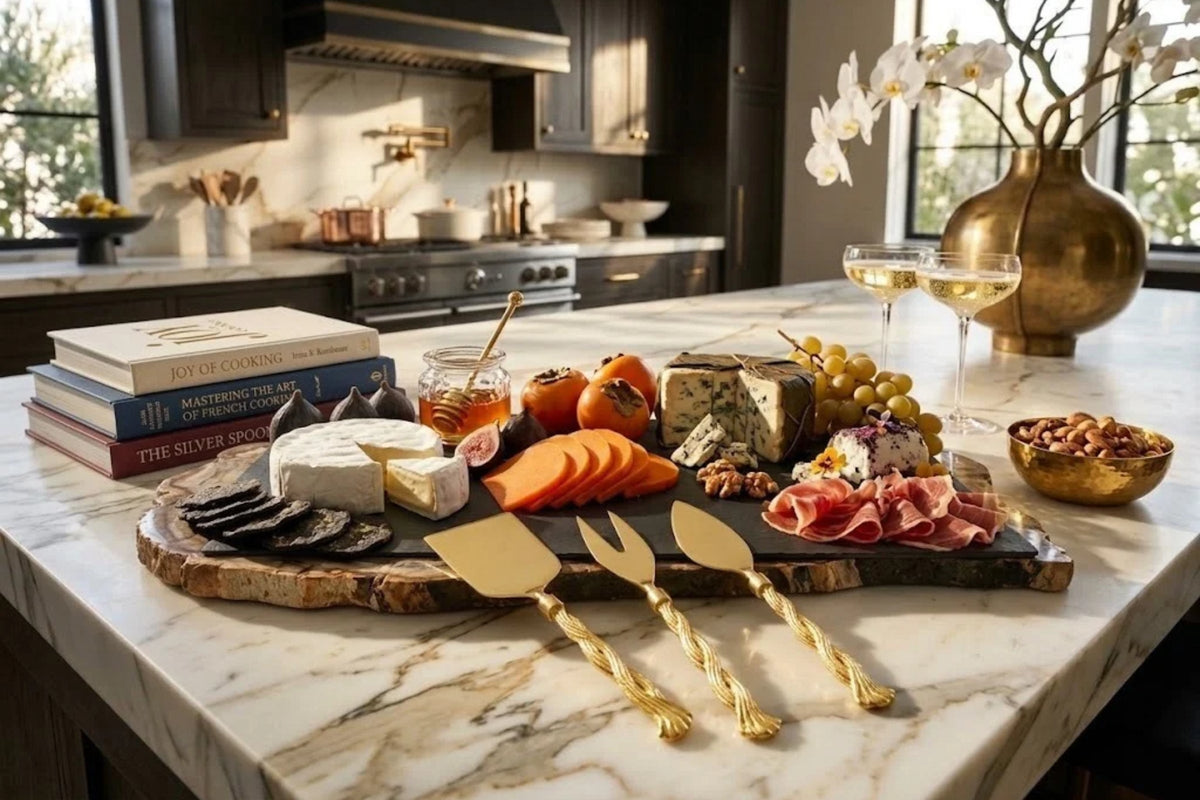
For a set that reads across a full board, the Derby knives in carved ivory resin carry a leaf blade, a serrated blade with a forked tip and a wide flat blade — the three-part division in its plainest form, at seven inches so each knife stays with its own cheese. The Santiago set on braided rope handles makes the same division in matte gold steel, the rope giving each blade a different weight in the hand.
Where the board is the surface as well as the arrangement, a solid stone board takes the knives directly — the Dakota board in Himalayan Brown marble is cut to a freehand outline and hangs from a leather cord, so it comes off a hook to a counter in one motion and holds the cold it was given.
Quick Answers
What are the three cheese knives for?
One for soft cheese, one for semi-firm, one for hard. The soft blade is narrow and often perforated so paste does not cling. The semi-firm blade has a forked tip, so a slice is cut and lifted with one tool. The hard blade is short and spade-shaped, made to break a wedge apart.
What are the holes in a cheese knife for?
They reduce the surface area that soft cheese can stick to. A ripe paste fails by gripping the blade, so the slice tears as it is drawn out. Perforations break that contact into intervals and the cut releases cleanly. A very narrow blade achieves the same result.
Why is a Parmesan knife short and thick?
Because hard cheese is broken, not sliced. A stubby spade-shaped blade with a strong point is driven into the wheel and levered, splitting the cheese along its own crystalline structure. A thin blade attempting the same cut bends, or reduces the wedge to fragments.
Should each cheese have its own knife?
For flavor, yes. A blade carries the cheese it last cut into the next one, and a blue will overwhelm anything it touches. Three knives distributed across a board also make the first cut easier for a guest, who otherwise hesitates over a single shared knife.
How many cheese knives do you actually need?
Three. Cheese firmness comes down to how much water the paste holds, and three blade shapes cover the full range from fresh and wet to extra hard. Larger sets of five or seven add a spreader, a plane or a scoop, which extend that same three-part logic rather than replacing it.
Final Note
A cheese knife set is one of the few pieces of tableware where the shape is entirely argument and not at all decoration. The holes, the fork, the stubby spade — each exists because a particular cheese behaves a particular way under steel, and none of them was arrived at for how it looks.
Which is why a set is worth choosing on the blades first and the handles second. The blades decide whether the board works. The handles decide whether it is still worth looking at when the board is empty.