How to Choose Bar Tools: What You Actually Need
Four tools make almost every cocktail. Everything after that is preference rather than need.
A jigger to measure, a shaker or mixing glass to chill, a strainer to separate the drink from the ice, and a bar spoon to stir. With those four, a Martini, a Negroni, a Daiquiri and an Old Fashioned are all within reach. Nothing else on a bar cart is load-bearing.
What separates one set from another is not the count of tools but how each is built — the volumes a jigger is marked to, whether a strainer seats in a tin or a glass, how long the spoon is and how the shaft is turned. Those details decide whether the tools get used or stay arranged. This piece is about selection; how to arrange a home bar is covered separately.
The Jigger
What size jigger do you need?
A double jigger marked 2 oz on one side and 1 oz on the other is the working standard in American bars. A 1.5 oz over 1 oz pairing is also common. In metric those are 60, 45 and 30 ml.
A cocktail is a ratio before it is anything else. Two parts spirit to one part sweet to one part sour is a formula that holds across dozens of drinks, and it only holds if the parts are actually measured. Free-pouring is a skill built on thousands of repetitions behind a bar; at home it is guesswork with a confident wrist.
The detail worth looking for is interior gradation. A jigger with lines cut inside the cones measures three-quarters, a half and a quarter of each side, so a single tool covers most of what a recipe asks for instead of two or three.
Shaken or Stirred
Which drinks are shaken and which are stirred?
Shake anything with citrus, cream, egg white or another cloudy ingredient, for roughly twelve to fourteen seconds. Stir drinks made only of spirits — Martini, Manhattan, Negroni — for thirty to forty-five seconds.
The rule is not etiquette. Shaking drives air into the liquid and breaks small chips off the ice, which gives a drink texture and a clouded appearance. In a sour, that is the point. In a Martini, it is the thing being avoided: a stirred drink chills and dilutes at the same rate without ever going cloudy.
Which of the two you do more of decides what you buy first. A household that mostly drinks spirit-forward cocktails needs a mixing glass and a bar spoon and can skip the shaker for a while. A household that drinks Margaritas needs the shaker.
The Shaker
Should you buy a Boston or a cobbler shaker?
A Boston shaker is two tins with no built-in strainer, holds more, and is the professional standard. A cobbler shaker is three pieces — body, built-in strainer, cap — and is simpler to use at home.
The Boston's advantage is capacity and a seal that breaks cleanly with a tap. Its cost is that it needs a separate strainer, and that the two tins must be seated squarely or they stick. The cobbler removes both problems and introduces one of its own: the small built-in strainer clogs on fruit and pulp, and the cap can freeze on.
Neither is wrong. The Boston rewards practice; the cobbler works on the first attempt.
The Strainer
What is the difference between a Hawthorne and a julep strainer?
A Hawthorne has a coiled spring around its edge and seats in a shaker tin. A julep is a perforated bowl on a handle and seats in a mixing glass. A fine mesh cone catches what either lets through.
The spring is the working part of a Hawthorne — it presses against the wall of the tin and holds back ice and fruit while the liquid passes. A julep strainer has no spring; it sits at an angle inside a mixing glass and blocks the large cubes used for stirring, which is all a stirred drink requires.
Double-straining is the third case. A shaken drink carries ice shards and citrus fragments through a Hawthorne, and pouring through a fine mesh cone held over the glass removes them. It matters most in drinks served without ice, where anything that comes through stays visible for the length of the drink.
The Bar Spoon
Why is a bar spoon twisted?
The spiral shaft turns against the wall of the mixing glass, letting the spoon travel smoothly rather than fighting the circular motion. It also lets liquid be poured down the shaft for layering.
Length is the other specification. Bar spoons run about ten to twelve inches so the bowl reaches the base of a full mixing glass while the hand stays clear of the rim. The bowl itself holds 5 ml in the American pattern — one teaspoon — and 2.5 ml in European and Japanese ones, which makes the spoon a measure as well as a stirrer.
Ends differ by tradition. A flat disc is used for muddling and cracking ice, a weighted teardrop for balance in the hand, a small fork for lifting a garnish without fingers.
What You Can Leave Out
Do you need a muddler?
Only if you make drinks built on fresh mint, fruit or sugar cubes — a Mojito, a Julep, a Caipirinha, an Old Fashioned made the older way. Otherwise it sits unused.
The same test applies to the rest of the drawer. Tongs earn their place if ice is served from a bucket rather than a tray. An opener earns its place immediately and costs almost nothing. Everything beyond that — stirrers, picks, pourers, strainer variants — is chosen because it is wanted, not because a drink requires it.
Buying the four and adding the fifth later is the more reliable order. Buying a twelve-piece set means owning eight tools whose function has to be looked up.

What the Tools Are Made Of
Which materials suit bar tools?
Stainless steel for anything touching the drink — it takes citrus and repeated washing without reacting. Handle materials vary widely, and the stand a set lives on is usually where the weight sits.
Handles are where sets separate. Mother of pearl, resin and stone each change what a tool feels like in use, and they change how a set reads on a counter between drinks — the tools are out for two minutes and visible for the rest of the evening.
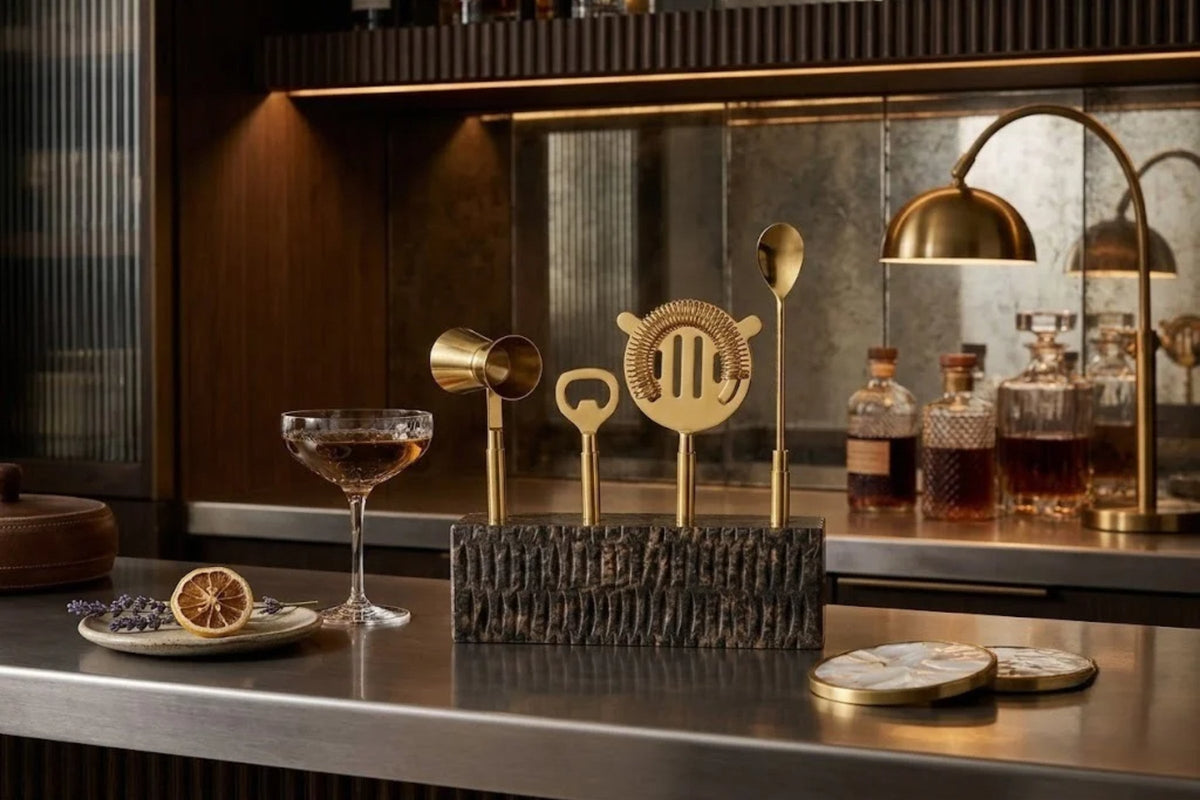
Stone bases do a specific job: they hold tools upright, off a wet counter, and heavy enough that pulling one out does not drag the stand with it. Travertine and onyx are both calcium carbonate, and both are porous to different degrees, so a base benefits from the same wiping-down a coaster does. The finish on the stone decides how visible that wear becomes.
Where the Set Sits
Does a bar tool stand matter?
It decides whether the tools are used. A set in a drawer is a set that gets skipped; a set standing at the edge of a counter is reached for without thinking.
The stand is also what keeps four objects from reading as clutter. Suspended from a rail or seated in drilled holes, the tools hold a single silhouette and a single footprint. Loose on a surface, the same four pieces read as things that have not been put away.
Placement and grouping — where the bar sits, what surrounds it, how much surface to leave open — matter as much as the tools themselves, and the piece on choosing a tray to define the surface covers the surface side of it.
Quick Answers
Which bar tools are essential?
Four: a jigger to measure, a shaker or mixing glass to chill, a strainer to separate the drink from the ice, and a bar spoon to stir. Almost every classic cocktail is made with these. A muddler, tongs and an opener are additions rather than requirements.
What size jigger should you buy?
A double jigger measuring 2 oz on one side and 1 oz on the other is the working standard in American bars; 1.5 oz over 1 oz is also common. In metric that is 60, 45 and 30 ml. Interior gradations let one jigger measure several volumes.
Which drinks are shaken and which are stirred?
Shake anything containing citrus, cream, egg white or another cloudy ingredient, for roughly twelve to fourteen seconds. Stir drinks made only of spirits — a Martini, Manhattan or Negroni — for thirty to forty-five seconds. Shaking aerates and clouds a drink; stirring chills it while keeping it clear.
What is the difference between a Hawthorne and a julep strainer?
A Hawthorne strainer has a coiled spring around its edge and seats in a shaker tin, the spring catching ice and fruit. A julep strainer is a perforated bowl on a handle and seats in a mixing glass. A fine mesh cone catches what either one lets through.
Why is a bar spoon twisted?
The spiral shaft turns against the wall of the mixing glass, letting the spoon travel smoothly rather than fighting the circular motion. It also allows liquid to be poured down the shaft for layering. Bar spoons run about ten to twelve inches, with a bowl holding 5 ml or 2.5 ml.
Final Note
The tools that get used are the ones whose function is obvious and whose place is fixed. A jigger with clear interior marks, a strainer matched to the vessel it seats in, a spoon long enough for the glass — none of that is refinement for its own sake. It is the difference between making a drink and approximating one.
What the set is made of decides the second question: what it looks like for the twenty-three hours a day no one is making anything. A stand carries that weight, in both senses. Chosen once, in a material that holds up to citrus and water, it is not a decision that needs revisiting.