How to Choose a Spoon Rest: Size, Weight and Stone
A spoon rest is sized to the widest spoon it has to hold and weighted so that nothing laid on it moves. Stone does both, provided acid is wiped away.
Choose a spoon rest by the widest spoon or ladle you cook with. Its bowl should sit entirely on the head of the rest, with the handle running back along the body rather than off the side. Then choose for weight: a rest of two or three pounds stays where it is set when a heavy ladle goes down on it, and a light one tips or slides.
Stone answers both questions at once. It takes a hot spoon without marking, it is heavy for its size, and a flat face clears with one pass of a damp cloth. What it asks in return is that tomato, wine and citrus come off promptly, because marble and onyx are both calcium carbonate and acid dulls them.
What a Spoon Rest Is For
Do you need a spoon rest?
If you cook with sauces, yes. It gives a working spoon somewhere to land that is not the counter, the pot or a folded paper towel, and it keeps every drip in one place that is washed after the meal.
Each of the alternatives fails in its own way. Left in the pot, a spoon slides under the surface or scorches against the hot rim, and a nylon tool can soften. Laid on the counter, the drip spreads, sets, and finds its way into grout or the pores of a stone worktop. A folded paper towel lets warm liquid soak straight through it, and a saucer works but adds one more dish to wash.
There is a quieter reason as well. A spoon that has stirred raw meat or egg carries it to wherever it is put down. A rest confines that to one surface that is washed when the cooking is done, and it makes the habit of changing to a clean spoon for serving an easy one to keep.

Sizing a Spoon Rest to Your Spoons
What size spoon rest do I need?
One whose head is as wide as the bowl of your widest spoon or ladle. Lay that ladle on it before deciding: the bowl should rest fully on the head, the handle running back along the body.
The bowl is the part that matters, because that is where the drip collects. A long ladle handle will always reach past the end of the rest, and that is expected. A bowl hanging over the edge is not, because it drips straight onto the counter the rest was meant to protect.
Length matters less than it seems; the stone rests here run 7.5 to 8.5 inches. Width is the real choice. A head 4 inches across gives a soup ladle room; a narrower head, around 3 inches, suits stirring spoons, spatulas and tasting spoons. Measure the bowl of the ladle you use most, not the one in the back of the drawer.
Why Weight Matters
Why should a spoon rest be heavy?
Because a ladle laid across it acts as a lever. The handle reaches past the end, and if the handle outweighs the rest, the rest tips up or slides away from it. Two or three pounds of stone holds still.
A light rest also travels. Every time a spoon goes down with a little force, a ceramic or plastic rest shifts an inch along the counter, and over a long braise it wanders toward the edge. A stone rest stays where it was set, which means the spoon can be put down without looking.
Keep the profile low. A rest under an inch tall lets a spoon go down at a shallow angle with no aiming, and a flat face is the easiest to keep clean: there is no well for sauce to dry into, and one pass of a cloth clears it. A rest with a deep dish holds a pool of liquid that then has to be carried to the sink.

Where It Sits
Can a stone spoon rest go on the stove?
Beside it, not on it. Stone takes a hot spoon without marking, but a burner or a hot grate heats one side of it far faster than the other, and uneven heat is what cracks stone. Keep it on the counter next to the cooktop.
Put it on the side you stir from, a short reach from the pot used most, and far enough from the cooktop edge that a pan handle swung toward it does not knock it. With two pots going, a second rest is simpler than moving one spoon between them, and it keeps the two sauces apart.
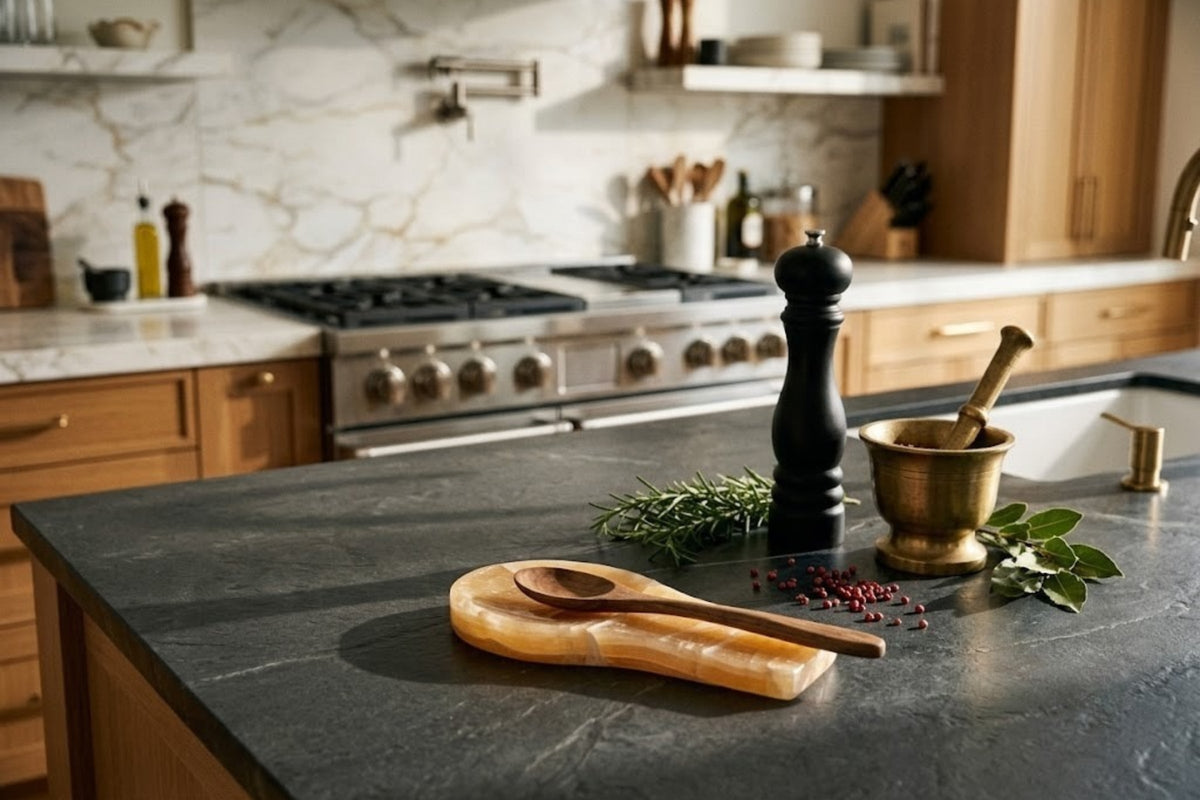
A stone rest left out between meals is also a small object on the counter, and it is worth choosing as one. Set beside the other things that live there, such as a mortar or a pair of mills, a plain stone holds the counter together rather than adding to it.
What Stone Asks For
Will tomato sauce mark a marble spoon rest?
It can if it is left. Marble and onyx are calcium carbonate, and acid, from tomato, wine, vinegar or citrus, etches a dull patch into the surface. Wipe the rest when the cooking is done rather than the next morning.
How much an etch shows depends on the finish. On a polished face it reads as a matte spot against the shine; on a honed face, already matte, it blends in. The difference is set out in honed versus polished surfaces, and the chemistry behind it in whether marble is safe for serving food.
Oil is the other thing to wipe away. Stone is porous, and cooking oil left on it can darken the surface. Warm soapy water and a soft cloth after cooking, then a dry towel, keeps the face clean. Stone does not go in the dishwasher and should not be left to soak; the broader routine is in caring for marble and onyx.

Choosing a Piece
The Machu Picchu spoon rest is onyx, polished, cream warming through honey and amber in parallel bands that run its length. A wide round head narrows into a straight-sided body, every edge continuous, 7.5 inches long and 3 inches across, about three pounds. Held to the light, the thinner edges carry some translucency, which is the clearest way to tell onyx from marble; marble versus onyx sets out the rest.
For a ladle, the wider heads. The Tunisia spoon rest is onyx in warm amber and honey with broad cream bands sweeping across it, honed rather than polished and finished with a chamfered edge that keeps the profile low, 8.5 by 4 inches. The Jaipore spoon rest is white marble, honed flat, 7.5 by 4 inches, with a floral inlay of abalone and mother of pearl set flush at the handle end. The paddle where a hot spoon lands is left plain, and the inlay is the part to keep oil away from.
On the same counter, the Beatrix mills are Terra Bianco marble carved in raised and recessed bands, with chrome knobs engraved S and P. For grinding rather than resting, choosing a mortar and pestle covers what stone does under the pestle.
Quick Answers
Do you need a spoon rest?
If you cook with sauces, yes. A spoon rest gives a working spoon somewhere to land that is not the counter, the pot or a paper towel. It keeps drips in one place that is washed after the meal, and it confines anything from raw meat or egg to a single surface instead of the worktop.
What size spoon rest should I buy?
Size it to the widest spoon or ladle you cook with. The bowl should sit fully on the head of the rest, with the handle running back along the body. A head about 4 inches across gives a soup ladle room; a 3-inch head suits stirring spoons, spatulas and tasting spoons. Measure the ladle you use most.
Is marble or onyx good for a spoon rest?
Both work well. Stone takes a hot spoon without marking, and two or three pounds of it stays put when a heavy ladle is laid across. Both are calcium carbonate, so tomato, wine and citrus should be wiped off after cooking. An etch shows more on a polished face than on a honed one.
Can a stone spoon rest go on the stove?
Keep it beside the cooktop, not on a burner or a hot grate. Stone handles a hot spoon easily, but direct heat warms one side far faster than the other, and that uneven heat is what cracks it. Set the rest on the counter, on the side you stir from.
How do you clean a stone spoon rest?
Wipe it with warm soapy water and a soft cloth once the cooking is done, then dry it with a towel. Do not soak it or put it in the dishwasher. Clear acidic sauces and cooking oil promptly, since acid dulls marble and onyx and oil can darken the stone if it is left to sit.
Final Note
A spoon rest is one of the smallest objects in a kitchen and one of the most used: set down and picked up dozens of times in a single meal. It earns its place by doing that without moving, marking or asking for attention.
Sized to the ladle, heavy enough to hold it, and wiped when the cooking is done, a stone rest stays on the counter for years. The surface that catches the drips becomes one of the things the counter is composed of.