Article: How to Choose Throw Pillow Sizes and Fills: Cover, Insert and Count
How to Choose Throw Pillow Sizes and Fills: Cover, Insert and Count
The Insert Decides How a Throw Pillow Looks, Not the Cover
Size the cover to the seat and the insert to the cover, and buy the insert two inches larger than the cover it goes into. A 20-inch square cover takes a 22-inch insert; a 16 by 24 lumbar takes an 18 by 26. That two-inch overlap is the whole difference between a pillow whose corners stand up and one that slumps and creases at the edges — and it is the reason a pillow that looked full in a photograph arrives looking flat when the insert was bought to match.
Fill is the second decision, and it is about use rather than looks. Feather and down compress under a shoulder and spring back when the pillow is shaken out, so they suit a sofa people sit right back into, and they want that shake every few days. Down alternative — a polyester fill — is springier and firmer, gives more support on a deep seat and holds its shape with no attention at all. Neither is better. One asks for a habit and the other does not.
What Size Throw Pillow Do I Need?
What size throw pillow do I need?
A 20-inch square is the working default for a sofa. Go to 22 or 24 inches on a deep or long sofa, drop to 18 on a small settee or an armchair, and use a 16 by 24 lumbar wherever the pillow has to support the small of a back rather than fill a corner.
The number that decides this is seat depth, not sofa length. A deep seat swallows an 18-inch square — it disappears into the back cushion and does nothing for the person sitting there. On a shallow seat, a 24-inch square does the opposite and pushes the sitter forward off the cushion. Measuring the seat from the front edge to the back cushion takes ten seconds and settles the question better than any rule about sofa size.
A lumbar pillow is a different tool rather than a smaller one. At 16 by 24 it sits across the width of a chair and takes the load at the base of the spine, which a square cannot do without being folded or punched. That makes it the right pillow for a dining chair someone lingers in, a reading chair, a window seat, and the center of a sofa where two squares already hold the arms.
Why the Insert Is Bought Two Inches Larger
Should a pillow insert be bigger than the cover?
Yes, by about two inches on each dimension. The fill then has to spread into the corners of the cover instead of settling in the middle, which is what makes a pillow read full and hold a square edge.
An insert bought to match the cover leaves the corners empty, and empty corners read as a limp pillow from across the room however good the cover is. Two inches is the standard overlap and it is enough; four inches starts to strain the seams and makes a cover hard to close. If a cover is being bought with its insert as a pair, that pairing is already matched and the rule does not apply — it matters when an insert is being replaced or sourced separately, which is when most people get it wrong.
There is a case for the opposite choice. A softer, flatter pillow that creases where someone leaned on it is a legitimate look, and a matched insert gives it. What is not a choice is buying a matched insert by accident and being disappointed with the result.
Feather Down or Down Alternative?
What is the difference between feather down and down alternative inserts?
Feather and down conform to whatever leans on them and need shaking out to recover; down recovers more strongly than plain feather. Down alternative is polyester, springier and firmer, gives more back support on a deep seat, and needs no maintenance at all.
The quality question inside feather inserts matters more than the label on the outside. A cheaply filled feather insert uses thick quill feathers, which feel prickly through a cover and work their way point-first through the fabric within a year or two. A good one is soft the whole way through and does not. Price is a rough guide here and the feel through the cover when you press it is a better one.
Down alternative wins on a different axis. It carries no quills, asks for no fluffing, and stays springy when a pillow is used as back support several hours a day rather than looked at. It does not have the yielding collapse that makes a down pillow pleasant to sink into. The honest way to choose is to decide whether the pillow is for sitting against or for the room.

How Many Pillows, and in How Many Sizes
How many throw pillows should a sofa have?
Two on a small sofa, three on a standard one, four or five on a long sectional. Use two sizes rather than three, and let the largest pair hold the arms with a lumbar or a smaller square between them.
The failure mode is a row of identical squares lined up edge to edge, which reads as upholstery rather than as a room someone uses. A pair at the arms plus one different pillow at the center gives the same coverage and reads as composed. On a long sectional the same logic repeats: pairs at the outer corners, one odd pillow at the turn.
Keep the count honest about the seat. Every pillow on a sofa is a pillow that gets moved before anyone sits down, and a sofa that has to be cleared to be used will quietly stop being used. Three is usually the point where a sofa is dressed and still available. Layering pillows, throws and rugs covers how the pieces sit together once the count is settled.
What the Cover Material Changes
Does the cover fabric change the insert you need?
It does. A dense embroidered face has body of its own and will hold a corner with a softer fill behind it. A fine plain-woven cotton has no structure at all and depends entirely on the insert for its shape.
Wool embroidery worked across a cotton ground adds real thickness to the face — the stitching stands proud, the ground behind it is stiffened, and the pillow keeps its outline even when the fill has been compressed. A plain cotton cover in the same size, with nothing worked into it, needs the two-inch insert and the firmer fill to look like anything. Wool and cotton behave differently under use in ways that show up here first.
Cover material also decides how the pillow is cleaned, which is worth knowing before rather than after. Wool embroidery on cotton is dry-cleaned; the raised stitching is what spot-cleaning damages, and a soaked ground dries unevenly around it. That is the argument for a removable cover over a sewn-shut pillow: the cover goes out to be cleaned and the insert stays home. Caring for textiles and pillow covers sets out the method.
Choosing a Pillow
Across the pillow covers here, the square measures 20 by 20 inches and the lumbar 16 by 24, and each cover is offered three ways: as a cover on its own, with a down alternative insert, or with a feather down insert. Buying the cover alone is the right move when there is already an insert in the house worth keeping — check its size against the two-inch rule before deciding.
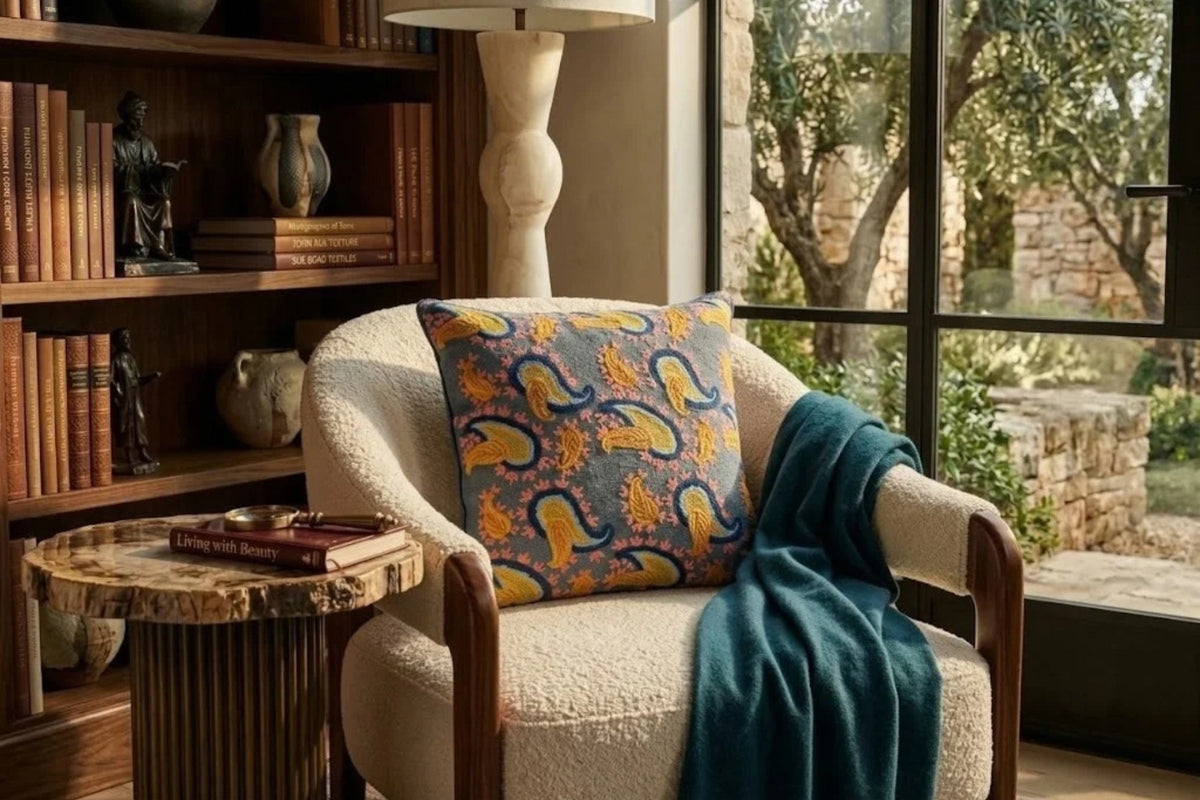
For a sofa square with real body in the face, the Havana pillow carries wool embroidery across its entire face, amber and olive paisley over a slate blue embroidered ground. The Holi pillow works terracotta, crimson and olive crewel embroidery into a central medallion on ivory cotton, and the Mandira pillow sets dense crewel work in magenta and pale gold over deep navy. For the small of a back rather than the corner of a sofa, the Unnao lumbar is cotton with raised rust floral stitching and a scalloped edge, at 16 by 24 inches.
Quick Answers
What size throw pillow do I need?
A 20-inch square is the default for a sofa, 22 or 24 inches on a deep or long one, and 18 inches on an armchair or small settee. Use a 16 by 24 lumbar where the pillow has to support a back rather than fill a corner. Measure seat depth first; it decides more than sofa length does.
Should a pillow insert be larger than the cover?
Yes, by about two inches on each dimension. A 20-inch cover takes a 22-inch insert. The fill is then forced out into the corners instead of settling in the middle, which is what makes a pillow hold a square edge. A matched insert leaves the corners empty and reads limp from across a room.
What is the difference between feather down and down alternative inserts?
Feather and down conform to whatever leans on them and recover when shaken out, with down springing back more strongly than plain feather. Down alternative is a polyester fill: springier, firmer, better back support on a deep seat, and it holds shape without fluffing. One asks for a habit; the other does not.
How many throw pillows should a sofa have?
Two on a small sofa, three on a standard one, four or five on a long sectional. Use two sizes rather than three, with a pair holding the arms and one different pillow between them. A row of identical squares reads as upholstery, and a sofa that must be cleared before sitting stops being used.
What size is a lumbar pillow?
Most lumbar pillows run 16 by 24 inches, with 12 by 20 and 14 by 20 also common. The long, shallow shape sits across a chair and takes the load at the base of the spine, which a square cannot do unfolded. Size its insert the same way: two inches larger on each dimension.
Final Note
Almost every disappointing throw pillow is a sizing problem wearing a fabric's clothes. The cover was chosen carefully and the insert was chosen to match it, and the result is a pillow that sags where it should stand. Two inches of overlap fixes that, costs nothing, and is invisible once the cover is on.
After that the decisions are about use. Fill follows how the pillow will be treated — shaken out or left alone. Size follows seat depth. Count follows whether anyone actually sits there. The cover, which is the part people choose first and the only part they see, is the one decision that can be made purely on how it looks, because everything holding it up has already been settled.