Matching Bath Sets or Separate Pieces: How to Decide
A matched set is the right start for most vanities. Fewer pieces, or separate ones, earn their place when the counter is shallow, the routine is small, or two people share the basin.
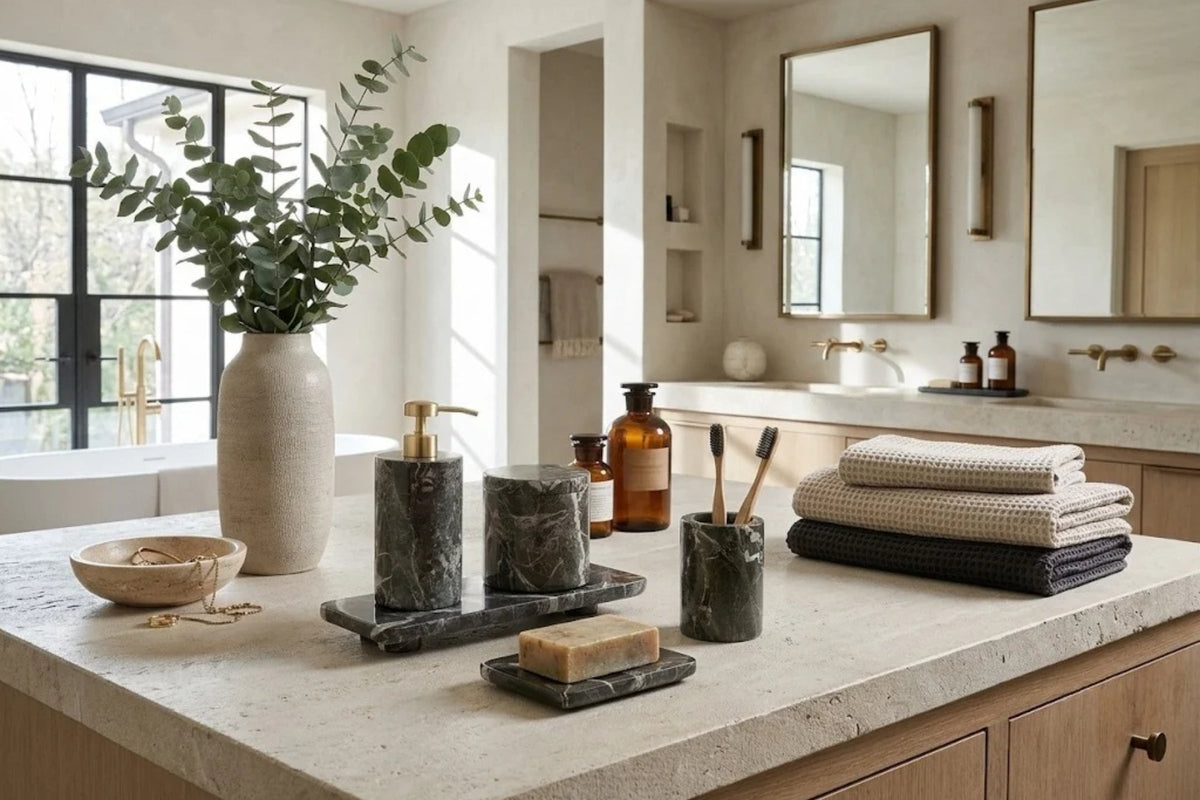
Buy a matched set when the counter can hold every piece in it and every piece will be used. One form repeated across a dispenser, a tumbler, a lidded jar and a soap dish reads as one object, which is why a set looks calmer than the same four jobs done by four unrelated containers.
Choose fewer pieces when the vanity is shallow, when a piece in the set would sit unused, or when the counter is shared. The decision comes from the counter depth beside the basin, the width clear of the tap, the number of people using it, and whether the household uses bar soap or pump soap.

Count the Jobs Before the Pieces
Should bathroom accessories match?
On one counter, usually yes. A matched set reads as a single unit, so four objects take the visual space of one. Matching means form, not pattern: in stone, every piece in a set carries its own veining, and that is expected rather than a flaw.
Start from the routine rather than the box. A household that uses pump soap has no need for a soap dish, and one that uses bar soap may not need a dispenser. A lidded jar earns its place only if there is something to keep in it, such as cotton rounds or hair ties. Every unused piece is counter given to nothing.
How the materials compare, and how a set and a tray differ as ways of gathering a counter, is covered in choosing bath accessories for function and form. The question here is narrower: a whole set, part of the same idea in fewer pieces, or separate pieces chosen one by one.
Measure the Counter First
How much counter space does a bath set need?
Set in a row with a little space between pieces, a four-piece set takes 16 to 20 inches of width and about six inches of depth. A five-piece set gathered on its own tray takes the tray's footprint, about 12 inches long and 4 to 6 inches deep.
A standard vanity is 20 to 22 inches deep and a shallow one 16 to 18, and most of that depth is basin. On a shallow or 24-inch vanity the free counter beside the basin is often a strip a few inches deep, and a four-piece row will not fit there without crowding the tap. That is the case for a pair: a dispenser and a tumbler, nothing more.
A tray changes the arithmetic. A five-piece set that includes a narrow footed tray occupies one rectangle instead of four separate footprints, and the footed base lifts the stone clear of water left on the counter.

One Basin or Two
Do you need two bath sets for a double vanity?
Usually, if both basins are used every day. Each person reaches for soap and a toothbrush at their own sink, and a single set placed between them serves neither well. Where the counter is tight, a dispenser and tumbler at each basin often works better than two full sets.
Double vanities usually start around 60 inches, which fits two basins but leaves little counter; 72 inches is more comfortable for two people. On the narrower size, two pairs keep each basin clear. On the wider one, two identical sets read as symmetry and suit a vanity built symmetrically.
Two different sets can work as well, provided one thing stays the same between them. The same stone in two forms reads as a family; two stones in the same form read as a pair. Two stones in two forms read as two separate purchases.

Match the Metal, Then Let the Stone Vary
Should the soap pump match the faucet?
It should match a metal already in the room. A bathroom reads calmest with two metal finishes, three at most, each repeated at least twice. A chrome tap takes a pump in a polished silver finish without question; a gold-finish pump beside chrome works when gold appears again nearby, in a mirror frame or a light.
The pump is the one place a stone set meets the fittings, so it is the detail to check before buying. A polished silver finish sits with chrome and nickel, a gold finish with brass and gold, and a matte black finish with black hardware. When the pump matches nothing else in the room it reads as a mistake rather than an accent.
Within a stone set the veining changes from piece to piece, and that is the stone rather than a mismatch; natural stone variations explains why. Travertine adds open pores that hold water, as travertine porosity and texture sets out, and the daily routine for any stone piece is in everyday care for bath accents.
Choosing a Set or a Pair
For a full set on one repeated form, the Marquina bath set is black Marquina marble in four pieces, a lotion dispenser, toothbrush holder, lidded canister and soap dish, each with a flat foot and polished to a high finish, with bold white veining and a metal pump in a polished silver finish. Because the form repeats, the veining is the only thing that changes between pieces. The Duval bath set does the same in white marble with fine gray veining, each piece on the same stepped base, with a metal pump in a polished silver finish.
For texture rather than polish, the Tallinn bath set is gray-brown travertine in four pieces chiseled in a diagonal relief, with a smooth canister lid and a metal pump in a matte black finish for black fittings. For a set gathered on its own tray, the Jardin Verde Levanto bath set is five pieces of honed Verde Levanto marble, deep forest green with white veining, including a narrow footed tray that holds the rest and a metal pump in a brushed gold finish.
For a shallow vanity or a narrow shelf, the Raavi bath set is a pair in white marble: a dispenser and a matching tumbler, ribbed the full height of both, with a metal pump in a polished silver finish. It is also the pair to place at each basin of a double vanity where two full sets would crowd the counter.

Quick Answers
Should bathroom accessories match?
On a single counter, usually yes. A matched set repeats one form across its pieces, so four objects read as one unit and the counter looks calmer. Matching means the form, not the pattern: every stone piece carries its own veining. If pieces are mixed, keep one thing constant, either the stone or the form.
Is a matching bath set better than separate pieces?
A set is better when the counter can hold it and every piece will be used. Separate pieces are better on a shallow vanity, where a dispenser and tumbler fit and four pieces do not, or when part of a set would sit unused, such as a soap dish in a household that uses pump soap.
How much counter space does a bath accessories set need?
A four-piece set in a row takes 16 to 20 inches of width and about six inches of depth. A five-piece set on its own tray takes about 12 inches by 4 to 6. On a vanity 16 to 18 inches deep, the counter beside the basin is often too narrow for four pieces.
Do you need two bath sets for a double vanity?
Usually, if both basins are used daily, since each person needs soap and a toothbrush at their own sink. On a 60-inch double vanity a pair at each basin often fits better than two full sets. On 72 inches or more, two identical sets suit a symmetrical vanity.
Should a soap pump match the faucet finish?
It should match a metal already in the room. Keep a bathroom to two metal finishes, three at most, and repeat each at least twice. A pump in a polished silver finish suits a chrome tap; a gold or matte black finish works when it appears again in a light, a mirror frame or the hardware.
Final Note
A bath set is chosen at the counter, not on the page. Measure the strip beside the basin, count the pieces the household actually uses, and match the pump to a metal already in the room. A set that fits all three will look like one object rather than four.
Where the counter is short, buy fewer pieces of the same form rather than a full set squeezed in. A pair that fits reads better than four pieces that crowd the tap, and the stone does the rest.